

Introduction
In fintech fundraising, your investor pitch is a make-or-break moment. Founders must translate complex technology, strict regulations, and ambitious market visions into a clear, compelling story that wins trust and capital. Yet, crafting the perfect PowerPoint deck often becomes a massive distraction from running the business itself.
This is why a strategic shift is underway: fintech innovators are embracing AI PowerPoint generators. These tools are far more than slide automatons; they are strategic partners for building data-driven, visually powerful, and deeply persuasive narratives. This article details the six compelling reasons for this adoption, showing how AI is turning the pitch deck from a time-consuming chore into a tangible competitive edge.
“The modern pitch deck is a data visualization and storytelling product. AI tools are now sophisticated enough to act as a co-pilot in its creation, ensuring technical accuracy and narrative flow—two elements VCs scrutinize heavily.” – Sarah Chen, Managing Partner, The Billion Dollar Fund
The Unique Pressure of Fintech Fundraising
Fintech startups face a uniquely intense spotlight. They must prove technological innovation, regulatory foresight, financial viability, and market traction all at once. Their pitch deck is a critical document that must balance deep technical detail with crisp business logic, all while projecting unwavering professionalism.
The stakes are quantified. A PitchBook survey revealed fintech deals require, on average, 28% more due diligence materials than other tech sectors. This makes the initial pitch’s clarity and completeness absolutely paramount for securing that crucial first meeting.
Conveying Complex Data with Crystal Clarity
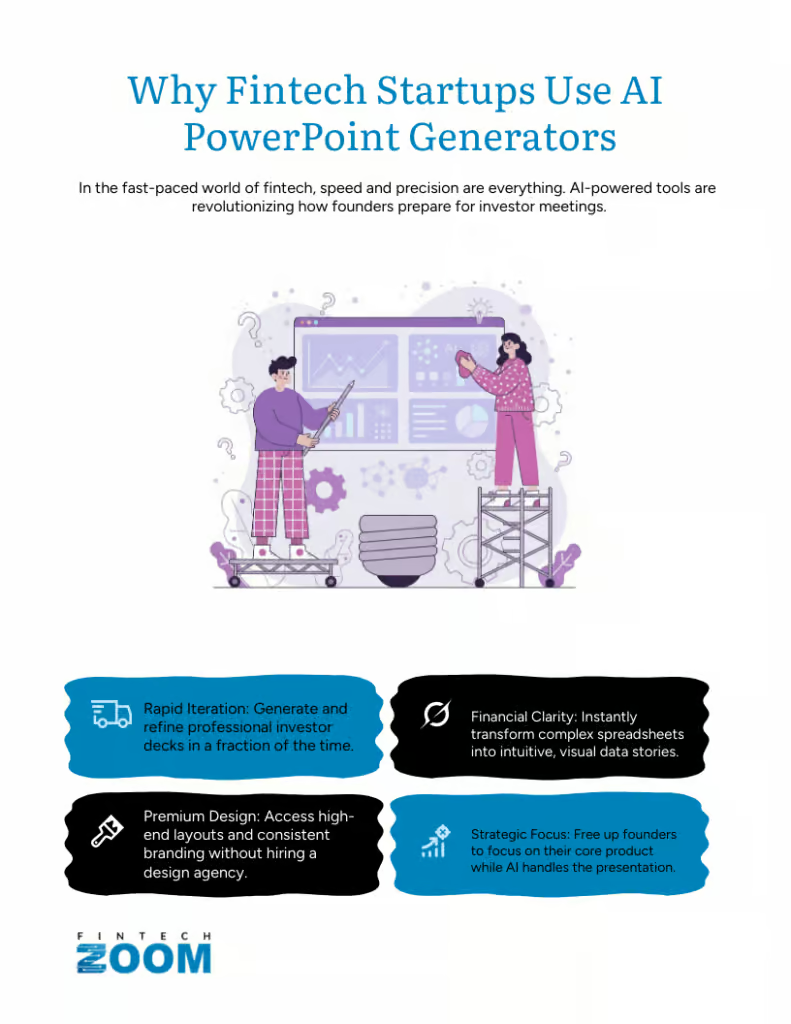
Fintech is built on data—unit economics, cohort analyses, risk models. Manually turning spreadsheets into clear charts can devour 40+ hours of a founder’s time. AI PowerPoint generators eliminate this grind by instantly transforming raw numbers into professional, intuitive visualizations. This allows founders to focus on the story behind the data, not the tedious formatting.
Beyond speed, AI ensures critical visual consistency. Every chart adheres to the same style, palette, and labeling, creating a unified front that subconsciously signals meticulousness and operational rigor to investors. This attention to data integrity in presentation builds subconscious trust, a non-negotiable currency in finance.
Keeping Pace with Lightning-Fast Competition
The fintech sector evolves daily. A startup may need to pivot its messaging overnight or tailor decks for different investors simultaneously. Traditional design workflows are simply too slow for this reality.
AI presentation platforms enable real-time iteration and precision tailoring. Founders can A/B test value propositions or generate investor-specific variants in minutes. For instance, a payments startup could use AI to quickly create three focused decks: one highlighting regulatory tech for a compliance-focused VC, another emphasizing scalability for a growth investor, and a third detailing tokenomics for a crypto fund. This agility is a direct competitive weapon.
Key Benefits Driving Adoption
The move to AI is driven by concrete benefits that solve core startup challenges. These advantages directly impact fundraising success, going far beyond mere convenience.
Reclaiming Precious Time and Resources
For a lean team, time is the ultimate resource. Spending weeks on slide design is a catastrophic misallocation of talent. AI automates the heavy lifting of layout, formatting, and structuring. A 2023 Venwise study found executives waste 15% of their fundraising time on deck design—time AI can give back.
This reclaimed time—often hundreds of hours per funding round—is redirected to high-value work: refining the business model, practicing the live pitch, and engaging with investors. The return on investment is both clear and immediate.
Guaranteeing Narrative Consistency and Elite Professionalism
A deck with mismatched fonts, inconsistent colors, and jarring visuals can sabotage a message of reliability. AI PowerPoint tools enforce brand and narrative cohesion from start to finish using master templates.
This creates a seamless, polished presentation that meets the professional standards of institutional investors, who view the deck as a proxy for the company’s operational discipline. In a trust-based industry, a flawless deck is your first and most important handshake.
Advanced AI Capabilities for Fintech
Modern AI tools offer specialized features tailored to fintech’s unique demands. They are evolving from simple design assistants into intelligent content partners.
Dynamic Data Visualization and Financial Storytelling
Top-tier AI tools integrate directly with data sources like Google Sheets or APIs to pull live metrics. They then intelligently suggest the optimal chart—a waterfall chart for burn rate, a Sankey diagram for payment flows—to tell the most compelling financial story, applying principles from leaders like Storytelling with Data.
This transforms the deck from a static PDF into a dynamic storytelling engine. Founders can visually demonstrate how key metrics are derived and projected, making their growth assumptions transparent and far more convincing to analytical investors. This process aligns with the principles of effective economic data visualization championed by leading financial institutions.
Structuring Regulatory and Compliance Narratives
A clear regulatory strategy is a cornerstone of any fintech pitch. AI generators with advanced language models can help structure this complex content by referencing frameworks like GDPR or PSD2, ensuring all critical compliance touchpoints are addressed systematically.
AI ensures no key regulatory box is left unchecked, demonstrating a proactive, mature approach to investors. All compliance content must be reviewed by qualified legal counsel, and founders should reference official resources like the FTC’s business guidance on privacy and security to inform their strategy.
Overcoming Common Startup Hurdles
Startups inherently lack resources. AI presentation tools directly level the playing field with larger, better-funded competitors.
Bridging the Design Expertise Gap
Most founders are experts in finance or tech, not graphic design. Hiring a freelance designer can cost $2,000 to $10,000+. AI democratizes high-quality design by automatically applying principles of visual hierarchy and alignment.
With intuitive templates, these AI-powered tools allow anyone to produce investor-grade slides. This ensures a startup’s visual communication matches the sophistication of its technology without straining the budget.
Streamlining Collaborative Workflows
Pitch deck creation is often a chaotic, collaborative process plagued by version confusion and feedback loops across endless email threads and files.
Cloud-based AI platforms centralize this chaos. Teams can comment, edit, and approve in real-time within a single source of truth. This streamlines collaboration, eliminates errors from outdated figures, and ensures everyone is perfectly aligned before the pitch meeting. This collaborative efficiency is a key component of modern AI-driven team collaboration as analyzed in industry research.
Implementing AI Generators: A Practical Guide
To maximize value, adopt AI strategically. Follow this actionable, six-step guide for fintech startups:
- Audit Your Current Process: Track time spent and identify bottlenecks (e.g., “We waste 30 hours formatting financials”). This reveals where AI will have the highest impact.
- Choose a Specialized Tool: Select a generator known for fintech needs: strong data viz, financial templates, and brand control. Trial options like Beautiful.AI, Gamma, or Tome for their specific fintech libraries.
- Develop a Core “Master” Deck: Use AI to build a comprehensive master deck covering every potential narrative section, from problem to financials to regulatory roadmap.
- Create Investor-Specific Variants: Leverage AI speed to tailor your master deck. Emphasize tech infrastructure for a technical partner, and unit economics for a growth-focused VC.
- Integrate Live Data Sources: Connect the tool to live BI dashboards or financial models. Ensure key metric slides (e.g., Monthly Recurring Revenue) update automatically, so your deck is never stale.
- Train Your Team & Designate an Owner: Ensure team proficiency. Appoint a “deck master” to manage the core template and maintain version control across all variants.
The Future of AI in Fintech Pitching
AI’s role in fundraising is just beginning. The future points toward predictive, interactive experiences that will further redefine startup-investor communication.
Predictive Content and Investor Insights
Next-gen AI could analyze an investor’s public portfolio, blog posts, and past Q&A from sources like SEC EDGAR to predict their concerns. Imagine a tool suggesting: “Highlight your fraud detection AI; this partner always asks about security in first meetings.”
This evolution turns the tool from an assistant into a strategic intelligence partner. It helps founders pre-emptively answer questions during deck preparation, not just react to them in the meeting.
Interactive and Adaptive Pitch Experiences
The static deck may evolve into an interactive, AI-driven command center. If an investor drills into customer acquisition cost, the founder could generate a real-time, deeper competitive analysis slide on the fly.
This adaptive capability fosters a conversational, responsive pitch. It demonstrates unparalleled mastery of the business and leaves a lasting impression of confidence and control, representing the merger of presentation software and interactive business intelligence.
FAQs
Modern AI generators are trained on vast datasets, including financial and technical documents. While they may not “understand” like a human, they excel at structuring complex information logically, applying financial storytelling frameworks, and creating visuals that clarify intricate models (like unit economics or payment flows). The founder provides the deep expertise; the AI provides the optimal structure and clarity for communication.
Security is paramount. Reputable, enterprise-grade AI presentation platforms operate with robust encryption, data privacy policies, and often offer on-premise deployment options. Before using any tool, scrutinize its security certifications (like SOC 2), data handling policies, and ensure it allows you to work with anonymized or aggregated data. Never input highly sensitive, non-public information without explicit verification of the platform’s security protocols.
AI generators deliver investor-grade professionalism with unmatched speed and consistency, making them ideal for lean startups. A human designer brings unparalleled creative strategy, custom illustration, and nuanced brand storytelling. The most effective approach is often hybrid: use AI to build the core, data-heavy structure and ensure consistency, then engage a designer for key branding slides (cover, vision, team) to add a unique creative flourish.
Prioritize these features: 1) Advanced Data Visualization: Direct spreadsheet/API integration and smart chart suggestions. 2) Fintech-Specific Templates: Pre-built slides for regulatory roadmaps, KPI dashboards, and market landscapes. 3) Strict Brand Control: Master template locking for fonts, colors, and logos. 4) Real-Time Collaboration: Cloud-based editing and commenting for teams. 5) Export Flexibility: Options for PDF, PowerPoint, and interactive web formats.
Comparison of Leading AI Presentation Tools for Fintech
| Tool | Key Strength | Best For | Data Integration |
|---|---|---|---|
| Beautiful.AI | Design intelligence & consistency | Teams needing brand-perfect, automated design | Google Sheets, Excel |
| Gamma | Interactive, web-native narratives | Creating engaging, link-shareable pitch experiences | Charts from CSV, live embeds |
| Tome | AI-driven narrative structuring | Founders who want to quickly draft and structure story flow | Embed from Figma, Tableau, etc. |
| Pitch | Real-time collaboration | Distributed teams needing seamless co-creation | Live Google Sheets, Salesforce |
Conclusion
For fintech startups, adopting an AI PowerPoint generator is a strategic imperative. It enhances efficiency, enforces professionalism, and amplifies persuasive power by automating design, ensuring consistency, and enabling advanced data storytelling.
This allows founders to focus on their ultimate goals: building a transformative company and delivering an unforgettable pitch. As AI advances, its role will expand from creating slides to crafting intelligent, adaptive narratives. In the race for capital, leveraging AI isn’t about keeping pace—it’s about seizing a decisive advantage. Begin integrating these tools now to transform your pitch deck from a static document into a dynamic engine for growth.