

Music transcription used to sit quietly in the background of the industry. Necessary, yes. Exciting, not really. It was slow work, detail-heavy, and often outsourced or postponed because of cost. For many creators, it simply wasn’t worth the effort unless absolutely required.
That perception is changing. Fast.
AI-powered transcription tools are turning recorded sound into structured, usable data in a fraction of the time it once took. Notes become notation. Lyrics become synchronized text. Entire arrangements can be mapped out digitally. And once music is converted into data, it stops being just audio. It becomes something that can be packaged, searched, licensed, and sold in multiple formats.
This shift isn’t just technical progress. It’s economic leverage.
Audio Is No Longer a Closed Format
An audio file by itself is limited. You can stream it. License it. Play it. But you can’t easily dissect it, index it, or repurpose it at scale without additional work.
AI transcription changes that equation.
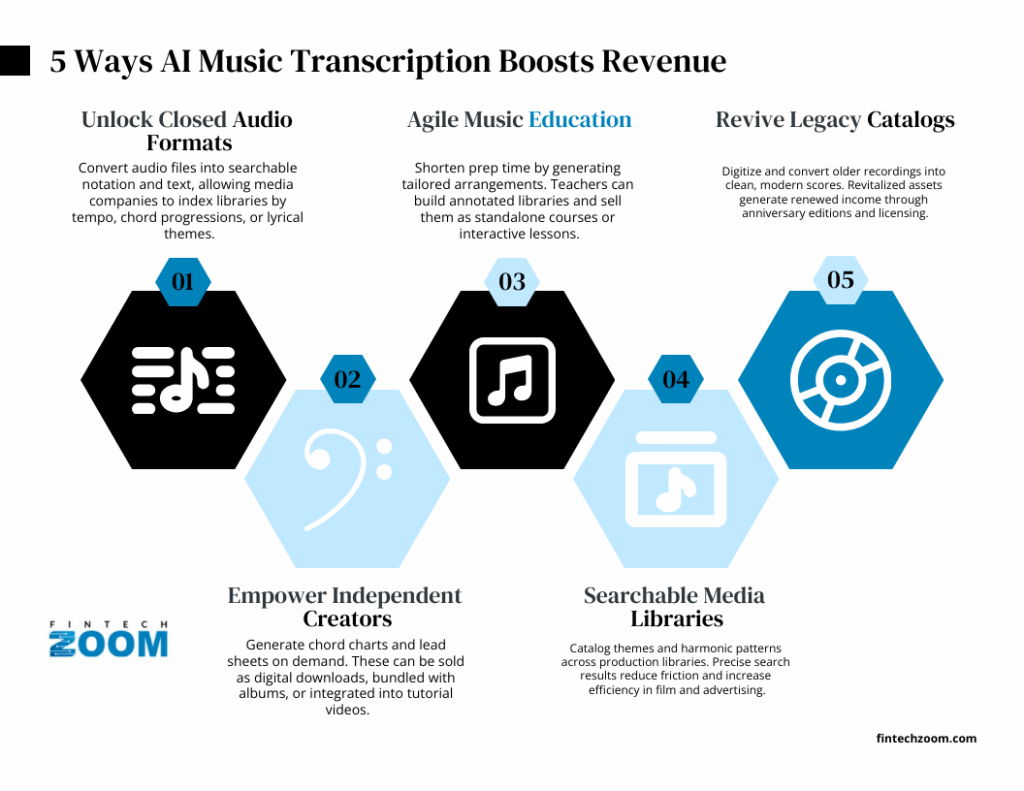
When a track is converted into notation or structured text, it becomes searchable and adaptable. Media companies can scan large libraries for specific tempos, chord progressions, or lyrical themes. Publishers can extract clean sheet music from recordings that never had official scores.
Suddenly, back catalogs look different. They look valuable in new ways.
What used to be archived as sound can now be reintroduced as educational material, collectible sheet music, or interactive digital assets. That transformation creates fresh revenue from material that already exists. No new recording session required.
Independent Creators Gain Practical Control
For independent artists, transcription has often been out of reach. Hiring professionals to notate every song adds up quickly. As a result, many musicians rely on unofficial fan-made tabs circulating online — sometimes accurate, sometimes not.
Now the barrier is lower. Much lower.
Using a reliable music AI transcription tool, creators can generate chord charts, lead sheets, and lyric timing files on demand. No waiting. No back-and-forth revisions stretching for weeks.
That immediacy matters.
Once the transcription exists, it can be sold as a digital download. Bundled with an album release. Added to a membership tier. Integrated into a tutorial video. One recording starts producing multiple types of products.
It’s not about replacing streams or touring revenue. It’s about layering income sources in a way that feels natural and sustainable.
Education Becomes More Agile
Music education thrives on access to accurate material. Yet preparing that material often consumes hours that could be spent teaching.
AI transcription shortens that prep time dramatically.
Teachers can generate arrangements tailored to their students’ skill levels. A dense arrangement can be simplified. A vocal line can be isolated. An instrumental part can be rewritten for a different ensemble.
This flexibility opens commercial possibilities too.
Online instructors can build structured libraries of annotated transcriptions and sell them as standalone courses. Learning platforms can integrate synchronized notation directly into their interfaces. When students can see the score move in time with the audio, engagement tends to rise.
Engagement leads to retention. Retention supports recurring revenue.
Media Libraries Become Searchable Assets
In film, television, advertising, and digital production, music is everywhere. But once a track is embedded into a project, its individual components often become harder to track.
Transcription adds clarity.
By converting sound into structured data, production teams can catalog themes, instrumentation, and harmonic patterns across entire libraries. Need a piece built around a minor progression at a specific tempo range? Search results become precise instead of guesswork.
That precision reduces friction.
Less time spent hunting for the right track means faster turnaround for campaigns and productions. In industries where deadlines are tight, efficiency itself becomes a financial advantage.
Data Starts Informing Creative Decisions
There’s another layer that’s easy to overlook. Once music is transcribed, it can be analyzed at scale. Patterns appear. Repetition becomes visible. Structural tendencies surface.
This doesn’t diminish artistry. It sharpens awareness.
Producers can study chord trends across genres. Artists can review their own catalogs to understand stylistic consistency. Platforms can analyze musical characteristics tied to listener retention.
Data doesn’t write songs. But it can highlight what resonates.
And when insights are paired with instinct, commercial potential increases.
Accessibility Expands the Market
Transcription also broadens who can engage with a piece of music. Time-coded lyrics support hearing-impaired audiences. Clear notation helps learners who process information visually. Structured text improves indexing on digital platforms.
Small additions, significant impact.
Greater accessibility often translates into wider reach. Wider reach supports stronger performance across streaming platforms and content channels. Metadata, accuracy, and clarity all play roles in discoverability.
Music that is easier to navigate is easier to monetize.
Reviving Legacy Catalogs
Large archives often sit underutilized because documentation is incomplete. Some recordings exist without official notation. Others were never fully indexed.
AI transcription offers a practical way to rebuild that infrastructure.
Older recordings can be digitized and converted into clean, modern scores. Anniversary editions can include newly formatted sheet music. Educational institutions can license structured materials from archival performances.
What was once locked in analog form becomes dynamic again.
And revitalized assets generate renewed income.
Human Oversight Still Matters
AI transcription is powerful, but it isn’t flawless. Complex polyphony, unconventional tunings, and expressive live improvisations can still challenge automated systems.
That’s where hybrid workflows come in.
AI handles the heavy lifting. Humans refine the details. This balance keeps production efficient while maintaining professional standards.
Legal considerations remain essential as well. Transcribing and distributing music requires proper rights management. Speed doesn’t eliminate responsibility.
The Direction Forward
Transcription tools are steadily integrating with digital audio workstations, publishing platforms, and educational systems. Real-time processing during live sessions is becoming more realistic. Interactive media formats are evolving.
The boundaries between listening and reading music are thinning.
When sound becomes structured information, it gains flexibility. It can be repackaged, searched, licensed, and taught in ways that weren’t practical before.
AI music transcription tools are not just automating a technical task. They are reshaping how musical content generates value.
And in an industry where diversification is no longer optional, that shift carries real weight.