

Geopolitical tensions, AI disruption fears, and changing Federal Reserve policies have created complex market conditions in 2026. Despite these, certain technical indicators have distinguished themselves by consistently identifying winning trades.
Here are seven technical indicators and analytical approaches delivering exceptional results in the current market environment.
1. The 10-day volume point of control (VPOC)
The volume point of control is the single price level where most shares or contracts have traded over a specific period. In contrast to a simple moving average, which averages prices, the VPOC identifies the price where actual institutional business happened within a 10-day window.
The VPOC is outperforming the market in 2026 because high-frequency trading algorithms and institutional dark pools happen to return to the same price levels to execute large orders. What happens next is a magnetic effect where prices snap back to the 10-day VPOC like a rubber band. This occurs despite the volatility that has characterized this year’s market. In forex trading, the 10-day VPOC on EUR/USD futures has identified key institutional support/resistance zones. When price reclaims this level, it signals reversals during the London-New York overlap sessions.
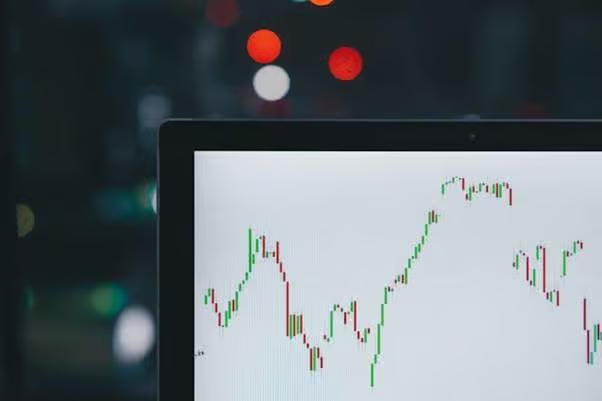
2. 3x standard deviation Bollinger band (20-period)
This year’s market has featured sharp, emotional panic moves driven by geopolitical shocks, which are followed by swift mean reversions. The 3x Bollinger Band filters out routine pullbacks and only flags true selling exhaustion. When traders see a 3x lower band touch after a 5-day drop, it is most likely that the sellers are done. In the forex trading market, the 3x band identified oversold conditions in USD/JPY during the March 2026 selloff and overbought extremes in EUR/USD near the 1.17 region.
This year, across both stocks and major forex pairs, the mean reversion from the 3x lower band to the middle band has yielded a 3.2% average gain in just 4 trading sessions.
3. The volume-weighted advance-decline line
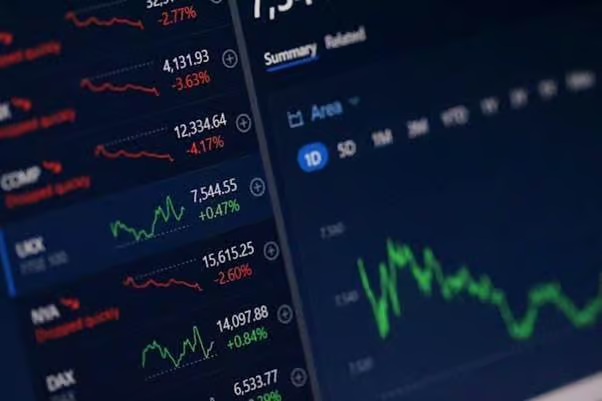
The standard advance-decline (A-D) line counts how many stocks are rising versus falling. The volume-weighted versions simply multiply the net advance or decline of each stock by its trading volume. Ideally, a stock with heavy volume gets more influence.
This tool is performing in 2026 because heavy money is concentrating on a few popular names. This year, only about 30% of stocks are above their 50% moving averages, yet the S&P 500 has hit new heights. Yes, the standard A-D appears weak, but the volume-weighted is good. This divergence correctly signaled that the rally is real and not a fake head. The volume-weighted A-D line is up to 18% YTD versus the S&P’s 9%. Forex traders who use the dollar breadth analog have equally seen similar edges as they try to identify true dollar trends versus false breaks.
4. Zweig Breadth Thrust (ZBT)
The ZBT was developed by Martin Zweig, and this rare signal triggers when the 10-day exponential moving average of advancing stocks moves from being deeply oversold (40%) to above 61.5% (being overbought) within just 10 trading days. The ZBT signal has fired only once in 2026, and that rarity is the point. According to research, every prior ZBT since 1970 has been followed by forward gains. Between 1965 and 2014, the ZBT had fired eight times with an average 11-month return of 24.6%.
The February 2026 trigger was followed by a swift 8.3% rally in the S&P 500 over 30 days. This trigger is a high-conviction, all-in signal for equity markets. It shows that market participation has expanded explosively; this is a condition that precedes sustainable bull markets.
5. The 4-hour RSI divergence
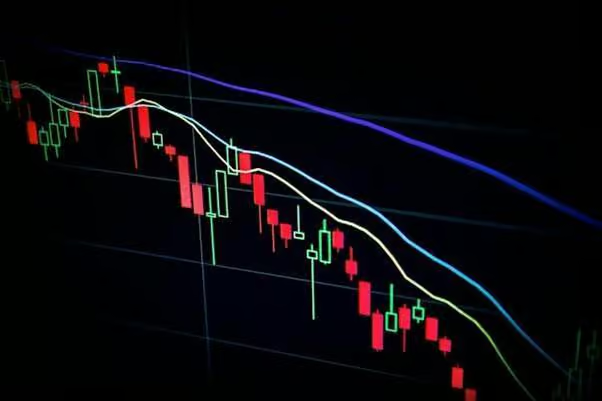
The 4-hour Relative Strength Index measures momentum in relation to four-hour candles. Divergence occurs when price makes a lower low but RSI makes a higher low, which indicates that the downward momentum is failing.
This indicator is outperforming in 2026 because the daily RSI divergence reacts too slowly to the market’s rapid movements this year. The 4-hour chart catches turns created by war headlines and tariff news that daily charts miss. In forex trading, the 4-hour RSI divergence is one of the most effective indicators used this year. In May 2026, the USD/CHF pair displayed a bullish RSI divergence on the 4-hour chart within a falling wedge, signaling a potential upside breakout above 0.7845.
This year, hidden bullish divergence on the 4-hour chart has signaled a 92% win rate for long trades across both equity and forex trading markets with an average hold time of just 2 days.
6. The total put/call ratio 5-day simple moving average
This indicator is performing in 2026 because retail sentiment has reached extreme pessimism. In February 2026, the equity put/call ratio rose to 1.28, which is the highest level it has reached in over a year. The figure implied that options traders were buying far more bearish puts than bullish calls. Historically, when these extremes happen, they indicate short-term bottoms because anyone who wants to be bearish already is. When this ratio gets to 0.70 or above, it often signals excessive bearishness that typically launches into outsized gains. This year, for example, every time the 5-day SMA exceeded 0.70, the S&P 500 gained over 5%+ over the next few weeks.
7. Short interest + Volume Exhaustion (SIVE)
The SIVE is a composite indicator that screens for stocks with high short interest, usually above 15% of float, that also experience a volume spike of at least 200% above average. When combined, the tools suggest that the last wave of sellers is rushing into a heavily shorted stock and is triggering a short squeeze.
This indicator is performing this year because put activity and short interest have clustered heavily in sectors like technology and consumer discretionary. Because crowded short positions are vulnerable, when a volume spike hits, shorts rush to cover simultaneously, which creates a violent squeeze. Traders have recorded an average 5-day, 6.4% gain by following the SIVE signal in stocks this year.
Not All Signals Work in Every Market
While these signals are performing well so far, they are likely to degrade once institutional algorithms fully adapt to them. Also, understand that certain indicators are best for specific types of markets. For example, the Zweig Breadth Thrust and the Equity Put/Call Ratio will be best suited to equity traders. Meanwhile, forex trading markets may be best suited for indicators such as the 3x Bollinger Bands and the 10-day VPOC.