
One day in Düsseldorf is usually nobody’s plan. It’s what happens when the conference wraps early, or the connection is long enough to actually leave the airport, or someone in the group says “well, we’re already here.” And then something slightly unexpected occurs: the city turns out to be worth the detour.
For travelers who want to structure the day properly rather than improvise, KubikTrip tours offers curated itineraries for Düsseldorf that can take some of the guesswork out of pacing – useful when you’re working against a tight clock and don’t want to spend the morning deciding.
That said, here’s what a well-spent day in Düsseldorf actually looks like.
Morning: Start Where the City Started
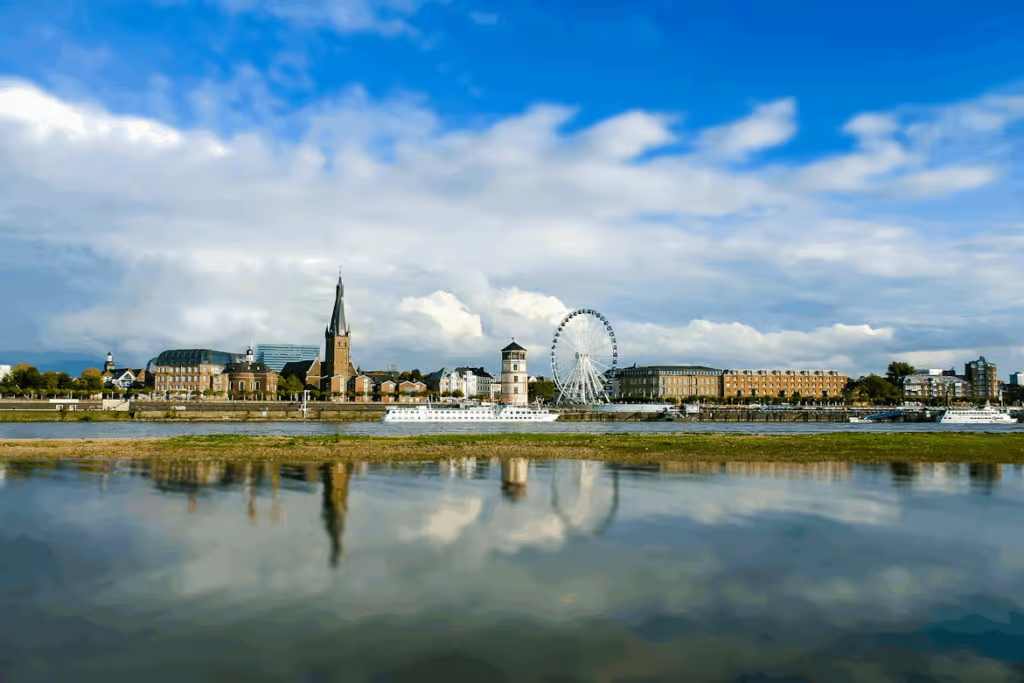
The Altstadt is the obvious beginning. It sits on the eastern bank of the Rhine, compressed into a roughly 15-minute walk end to end, and it manages to be simultaneously historic and entirely alive in the way that some preserved old quarters in German cities aren’t. There are medieval churches, baroque facades, and at street level, a density of bars that earned Düsseldorf the somewhat chaotic title of “the longest bar in the world” – over 260 drinking establishments in an area of less than one square kilometer.
In the morning, before any of that matters, the Altstadt is quieter and shows a different side. The Marktplatz, the central square, is anchored by the equestrian statue of Elector Jan Wellem – cast in 1711 and still one of the finest baroque bronze sculptures in Germany. The detail on the horse alone is worth stopping for.
From the Marktplatz, the Burgplatz is a few minutes on foot – a riverside square with the round Schlossturm (castle tower), which is the last remnant of the ducal palace that burned down in 1872. It now houses a small shipping museum that’s worth thirty minutes if the Rhine’s history interests you, and easy to skip if it doesn’t.
The Rhine Promenade: Where Düsseldorf Actually Lives
The Altstadt is where you get your bearings. The promenade is where you forget about getting your bearings and just walk.
The Rhine here is wider than most people expect – slow, working, with barge traffic moving through at a pace that makes the whole thing feel unhurried in a way the city centre doesn’t. The path runs for several kilometres north from the Burgplatz and the further you go, the more it stops feeling like a tourist route.
Late morning is the right time. The serious joggers are gone, the terraces are unlocking their chairs, the light off the water is doing something good. It’s one of those stretches of city that doesn’t ask anything of you.
The Rheinturm appears somewhere along the walk – 240 metres, the tallest thing in Düsseldorf, hard to miss. The observation deck is worth going up for the geography alone: the Rhine bending north toward the Dutch border, the Ruhr sprawl sitting grey on the eastern horizon. Less obviously: the tower runs a clock along its base using a pulse-count light system, which sounds like a footnote but is one of those small details that sticks. The kind of thing you find yourself explaining to someone later and realising you actually liked it.
Afternoon: Königsallee and the Museum Quarter
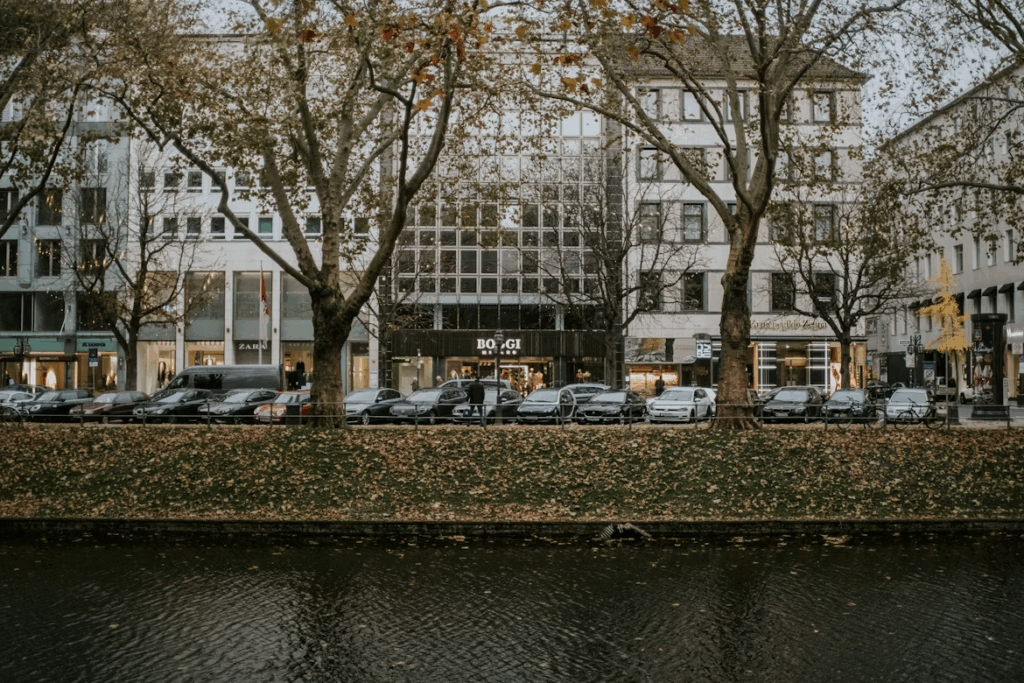
After the river, the natural move is east toward the Königsallee – universally called the Kö by locals, which is either charming or slightly affected depending on your mood. It’s Düsseldorf’s answer to a grand boulevard: a tree-lined canal running down the center, luxury retail on both sides, and a pedestrian atmosphere.
The Kö is worth walking even if you have no intention of going into any of the shops. The canal has swans. The architecture is self-consciously elegant. It’s the part of Düsseldorf that the city’s fashion industry reputation – this is, after all, Germany’s fashion capital, with more international fashion companies based here than anywhere else in the country – makes complete sense.
From the southern end of the Kö, the museum quarter is a short detour. The Kunstpalast holds a permanent collection that spans decorative arts, paintings, and glass. The K20 – Kunstsammlung Nordrhein-Westfalen – has one of the strongest collections of 20th-century art in Germany, with significant works by Klee, Picasso, and a particularly strong Expressionist section. Neither demands hours; an hour and a half covers the highlights without rushing.
Evening: Back to the Altstadt, This Time at Night
The Altstadt in the evening is a different proposition from the Altstadt in the morning, and that contrast is one of the better things about spending a full day in Düsseldorf. The bars open properly, the restaurants fill up, and the streets take on a different energy – louder, more social, considerably less historic-monument-adjacent.
Altbier is the local drink. It’s a dark, top-fermented ale that’s been brewed in Düsseldorf since the 14th century and which locals treat with a mild but firm defensiveness, particularly in relation to Cologne’s Kölsch, which is the other famous Rhine city’s equivalent. The two cities have an ongoing rivalry about this that is both completely serious and entirely good-natured, depending on who you ask. The Uerige brewery on Berger Strasse brews on-site and serves directly – the straightforward choice.
Bottom Line
The war took more than half the city’s buildings and damaged most of what survived. What was built in their place was functional, deliberate, and occasionally interesting – a city that decided to become good at business rather than mourn what it lost. It worked. L’Oréal, Vodafone, Henkel, Mercedes-Benz all have significant operations here. The name translates literally as “village on the Düssel river,” which stopped being accurate sometime around the industrial revolution and never looked back.
None of that means Düsseldorf is all boardrooms and early checkout. It just means the city has a different kind of energy than somewhere built primarily for visitors – and that difference, once you feel it, is actually part of the appeal.