

Students make more serious decisions than many people realise. Course choices, debt, part-time work, internships, digital tools, career direction, and online advice all compete for attention. The problem is not a lack of information. It is having too much information without a clear way to judge it.
That is why decision making and risk awareness are now core life skills. A student who can slow down, compare options, and think clearly under pressure has an advantage in education, work, money management, and long-term planning.
Why Decision-Making Skills Matter More in Modern Student Life
Student life used to follow a more predictable path: study, graduate, apply for work, build a career. That path still exists, but it is no longer the only route. Students now compare degrees with online courses, employment with freelancing, and traditional careers with AI-driven industries.
Students Face More Information Than Ever Before
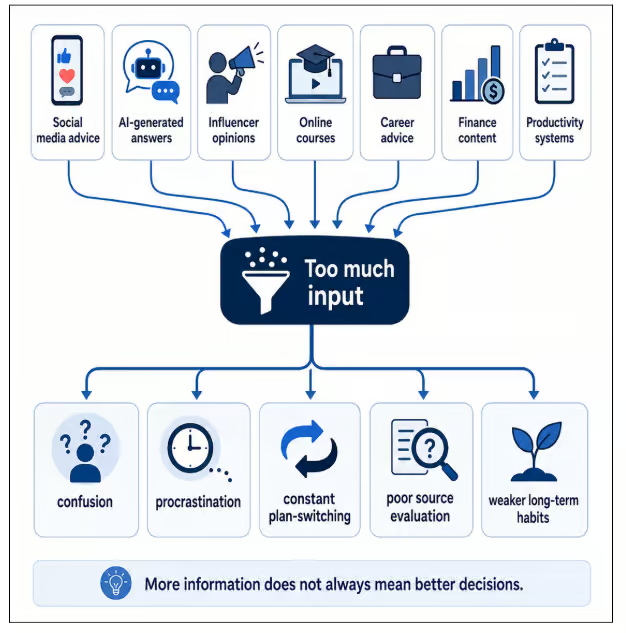
Social media, AI tools, influencers, finance content, productivity advice, and career platforms can all be useful. They can also create confusion. When every source gives a different answer, it becomes harder to identify what is credible and what is simply loud.
This is where students need structure. Without it, they may save too many resources, change direction too often, or copy someone else’s path without understanding whether it fits their own goals.
Alongside government-backed educational resources, some modern finance education platforms now also explore how structured analytical systems, including areas such as Forex Trading Bot technology, can influence decision-making, emotional discipline, and risk awareness in increasingly digital financial environments.
Why Young Adults Often Struggle With Long-Term Decisions
Long-term thinking takes practice. A choice that feels urgent at 20 may look very different at 25, especially when money, career goals, and personal priorities are still developing.
The National Institute of Mental Health explains that the prefrontal cortex, the part of the brain involved in planning, prioritising, and decision-making, continues developing into the mid-to-late 20s. This does not mean young adults cannot make strong decisions. It means they benefit from frameworks that slow the process down and make consequences easier to see.
The Difference Between Reactive and Structured Thinking
Reactive thinking is fast and emotional: “I need to decide now.” Structured thinking is slower and more useful: “What are my options? What could go wrong? What matters most later?”
This is the basis of structured decision-making. It does not remove uncertainty, but it helps students avoid decisions driven only by panic, pressure, or online influence.
Understanding Risk Management in Everyday Life
Many people hear risk management and think of banks, insurance firms, or corporate compliance. In reality, the same logic applies to everyday choices. Students manage risk when they budget, choose modules, accept freelance work, prepare for exams, or plan a career move.
What Risk Management Actually Means in Real Situations
If someone asks “what is risk management?”, the simplest answer is this: it is the process of identifying what could go wrong, judging how serious it could be, and taking steps to reduce avoidable damage.
For example:
| Situation | Possible Risk | Smarter Response |
| Choosing a course | Poor fit with career goals | Compare modules, outcomes, and workload |
| Taking freelance work | Unclear payment terms | Agree on the scope, deadline, and payment in writing |
| Managing student money | Overspending early in the term | Set weekly limits and track fixed costs |
| Applying for jobs | Too few applications | Build a repeatable weekly application system |
In finance, the question “What is finance risk management?” usually refers to protecting money from unnecessary loss. In daily life, the same idea applies to time, energy, reputation, and future options.
Why Avoiding Every Risk Usually Creates Bigger Problems
Avoiding risk can feel safe, but it often limits growth. A student who never applies for competitive internships avoids rejection, but also avoids opportunity. A graduate who never learns new tools avoids discomfort, but may fall behind.
The goal is not to remove every uncertain choice. It is to take controlled risks: prepare first, understand the downside, and set limits before acting.
How Structured Risk Assessment Helps Reduce Stress
A clear risk management process reduces stress because it turns vague worry into specific questions:
- What exactly could go wrong?
- How likely is it?
- How serious would the impact be?
- What can I do now to reduce the damage?
Ready.gov describes risk assessment as a way to identify hazards and analyse potential impacts. Although designed for preparedness planning, the logic is useful for individuals, too.
Moreover, Investor.gov explains that risk involves uncertainty and possible financial loss, and that understanding risk tolerance is important for long-term stability.
The Skills That Help People Make Better Decisions Under Pressure
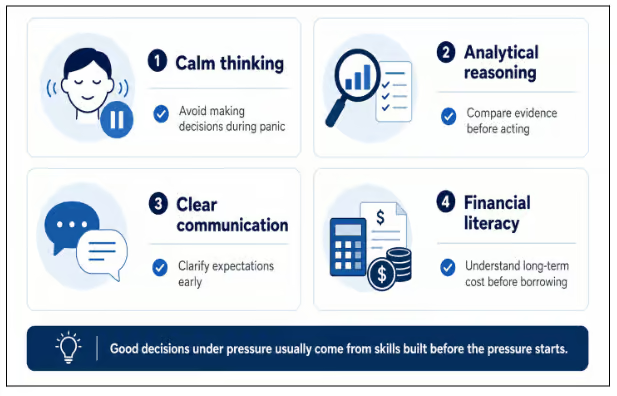
Pressure affects judgment. Exams, interviews, money problems, workplace conflicts, and trading decisions can all push people toward quick reactions. The skill is not to avoid pressure completely. It is to build a pause before responding.
Learning to Stay Calm During Uncertainty
A useful question is: Can you make logical trading decisions under stress? The same question applies before an exam, during a difficult conversation, or when choosing whether to accept a risky opportunity.
Good decisions under pressure usually come from rules made in advance. For instance, a student might decide not to apply for jobs after midnight, not to borrow money without comparing costs, or not to make major choices while angry or panicked.
Analytical Thinking Is Becoming More Valuable Than Memorisation
Memorisation still matters, but modern careers increasingly reward people who can evaluate information, spot patterns, and solve problems logically.
Analytical thinking helps students ask better questions:
- Is this source reliable?
- What evidence supports this claim?
- What are the hidden costs?
- What happens if my assumption is wrong?
These questions matter in academic research, career planning, budgeting, and decision making in finance.
Communication and Negotiation Reduce Everyday Risks
Many avoidable problems start with unclear communication. A vague deadline, poorly defined freelance project, misunderstood group task, or emotional message can create stress that could have been prevented.
Strong communication reduces risk because it clarifies expectations early. Negotiation also matters. Students and young professionals who can ask clear questions about pay, workload, deadlines, or responsibilities are less likely to accept poor conditions without realising it.
Financial Literacy Helps People Make Smarter Long-Term Choices
Financial literacy is not only about investing. It includes budgeting, debt, saving, interest rates, tax basics, and understanding how small choices accumulate.
A student who understands money basics is less likely to make impulsive decisions. They can compare short-term comfort with long-term cost, which is the foundation of financial risk management.
How Digital Environments Influence Modern Decision-Making
Digital platforms shape how people think. Algorithms reward speed, emotion, novelty, and repetition. That makes careful decisions harder, especially for students who rely on online spaces for education, work, news, and social connections.
Social Media Often Rewards Emotional Reactions Instead of Rational Thinking
Viral content usually moves fast. It rewards confidence over accuracy and intensity over balance. This can distort expectations around success, productivity, money, and careers.
A student watching constant “success” content may feel behind, even when they are building steadily. That pressure can lead to rushed courses, poor financial choices, or unrealistic career expectations.
Why Structured Educational Resources Matter More Than Online Hype
Good education explains context, limits, and trade-offs. Hype creates urgency and makes complex topics look simple.
Structured resources are especially valuable in financial topics. Concepts such as trading risk management, budgeting, and long-term planning help students understand why attractive opportunities still need careful evaluation.
Why Automation and AI Make Critical Thinking Even More Important
AI tools can improve productivity, summarise information, and support research. They can also produce errors, repeat weak assumptions, and make users dependent on answers they have not checked.
The strongest students will not be the ones who use the most tools. They will be the ones who can judge when a tool is useful, when it is wrong, and when a decision still needs human responsibility.
Practical Ways Students Can Improve Risk Awareness and Decision-Making Skills
Better decisions come from repeatable habits. Students do not need a complicated system. They need enough structure to prevent important choices from being made purely out of stress, mood, or online pressure.

Building Better Habits for Long-Term Thinking
Small habits improve judgment because they create distance between emotion and action:
- Write down major decisions before making them.
- Wait 24 hours before non-urgent financial choices.
- Review one mistake each week without blaming yourself.
- Plan the week before deadlines create panic.
These habits make thinking visible. Once a decision is written down, weak reasoning becomes easier to spot.
Learning to Separate Emotion From Analysis
Cognitive bias means the mind uses shortcuts. A student may trust a confident influencer, avoid an opportunity after one bad experience, or believe a trend is safe because many people are following it.
The solution is not to remove emotion. It is to notice when emotion is leading and bring analysis back into the process.
Using Simple Frameworks to Make Smarter Decisions
A basic decision making model can help with almost any complex choice.
| Step | Question to Ask | Example |
| Define | What decision am I really making? | Choosing a course, job, tool, or financial option |
| Compare | What are my realistic options? | List 2–4 choices, not 20 |
| Assess | What are the risks and benefits? | Cost, time, stress, opportunity |
| Decide | What option fits my priorities? | Choose based on evidence, not pressure |
| Review | What did I learn? | Improve the next decision |
This is also useful for anyone learning how to make a decision under uncertainty. Pros and cons lists, scenario planning, probability thinking, and worst-case analysis all help turn confusion into structure.
Why Consistency Usually Beats Impulsive Motivation
Motivation is useful, but unreliable. Consistency works because it does not require the perfect mood.
The student who studies 40 focused minutes each day often outperforms the student who waits for a dramatic burst of energy. The same applies to saving, learning digital skills, fitness, career planning, and risk management trading.
Why Risk Management Skills Will Become Even More Important in Future Careers
Modern careers are less predictable than they used to be. AI disruption, inflation, remote work, changing industries, and portfolio careers all require people to make decisions without perfect information.
Economic Uncertainty Is Increasing the Need for Structured Thinking
Students entering the workforce may face job markets that change quickly. Some roles will evolve, some will disappear, and new ones will appear faster than traditional education can respond.
Structured thinking helps people adapt without panic. It supports retraining, budgeting, career pivots, and realistic planning.
Employers Value Adaptability and Problem-Solving More Than Ever
Employers need people who can handle ambiguity. Technical knowledge matters, but so does the ability to analyse a problem, communicate clearly, and recommend a sensible next step.
This is why risk management positions exist across finance, insurance, operations, compliance, cybersecurity, project management, and consulting. The same underlying skills help people who never work in formal risk roles.
Strong Decision-Making Skills Create Long-Term Stability
Strong decisions compound. Better study habits, fewer impulsive money choices, useful digital skills, and stronger professional relationships all create future stability.
In markets, forex risk management focuses on limiting downside before chasing returns. In life, the principle is similar: protect the foundation first, then pursue growth.
Key Takeaways
- Decision-making and risk management are essential life skills, not just business concepts.
- Information overload makes structured thinking more important for students and young professionals.
- Financial literacy and analytical thinking reduce impulsive choices.
- Employers increasingly value adaptability, communication, and problem-solving.
- Structured educational resources are often more useful than emotionally driven online advice.
FAQ
Risk management means identifying what could go wrong, thinking through the consequences, and taking steps to reduce harm. It does not mean avoiding every risk. It means making risk more visible and manageable.
Students often face too much information, academic stress, financial uncertainty, social pressure, and limited long-term experience. When choices feel urgent, it becomes easier to react emotionally rather than think clearly.
Structured decision-making breaks a vague problem into smaller parts. Instead of asking “What should I do?”, the person asks: What are my options? What are the risks? What matters most? What is the next sensible step?
Financial literacy helps young adults understand budgeting, saving, borrowing, debt, interest, and long-term planning. These skills reduce impulsive decisions and make it easier to build stability.
Yes. Risk management skills help with education, careers, productivity, freelancing, leadership, and personal planning. Any situation involving uncertainty can benefit from clearer thinking and better preparation.
AI, automation, and digital workplaces have made problem-solving more valuable. Employers need people who can assess information, spot weak assumptions, communicate clearly, and make practical decisions when conditions change.