
It’s a scenario that catches many US buyers off guard. A precision machining center, freshly imported from Germany at a cost of $80,000, arrives at the facility after weeks in transit. The team powers it up — and the motor hums, strains, but never quite turns over. The culprit, more often than not, is something that never made it onto the purchase checklist: a mismatch between the machine’s electrical requirements and what the US power grid actually delivers.
The good news is you don’t have to replace your equipment. A single-phase frequency converter can get your imported machines running safely and reliably on US power, whether the issue is voltage, frequency, or both. To address these technical barriers, specialized systems like the PowerHome Single Phase Frequency Converter have become a standard industry fix, providing the precise, stable power required for high-value imported equipment to operate at peak performance.
Why Imported Machines Fail on US Power Supply
Most problems happen because different countries operate on different electrical standards. Machines built for one grid may be fundamentally incompatible with another, causing anything from sluggish performance to permanent damage.
Voltage Differences (110V vs. 220V Systems)
Many imported machines — especially those from Europe and Asia — are designed for 220V or 230V systems. Standard US residential and light commercial service is 120V, with 240V available at specific outlets. If your imported machine expects 220V and receives 120V, it simply won’t develop enough power to start or run correctly. Conversely, plugging a 110V-rated device into a 220V source can instantly destroy motors and electronics.
Frequency Mismatch (50Hz vs. 60Hz)
The US power grid runs at 60Hz, while most of Europe, Asia, Africa, and Australia operate at 50Hz. This 20% difference has a real impact on motor-driven equipment. AC motors are designed to spin at a speed tied directly to the supply frequency. A motor built for 50Hz will run roughly 20% faster on 60Hz power — leading to overheating, accelerated wear, and incorrect output speeds in machinery like lathes, pumps, and conveyor systems. Precision equipment such as CNC machines and lab instruments can produce flawed output simply because the timing signals are off.
Why This Problem Is More Common Than You’d Think
US manufacturers and small businesses increasingly source high-quality specialized equipment from overseas to stay competitive. German engineering, Japanese precision tools, Italian textile machines, and South Korean industrial equipment are all popular imports. Many buyers focus on the machine’s specs and price — only to discover the power compatibility issue after delivery. Without a solution in place, that equipment becomes an expensive paperweight.
What a Single-Phase Frequency Converter Does
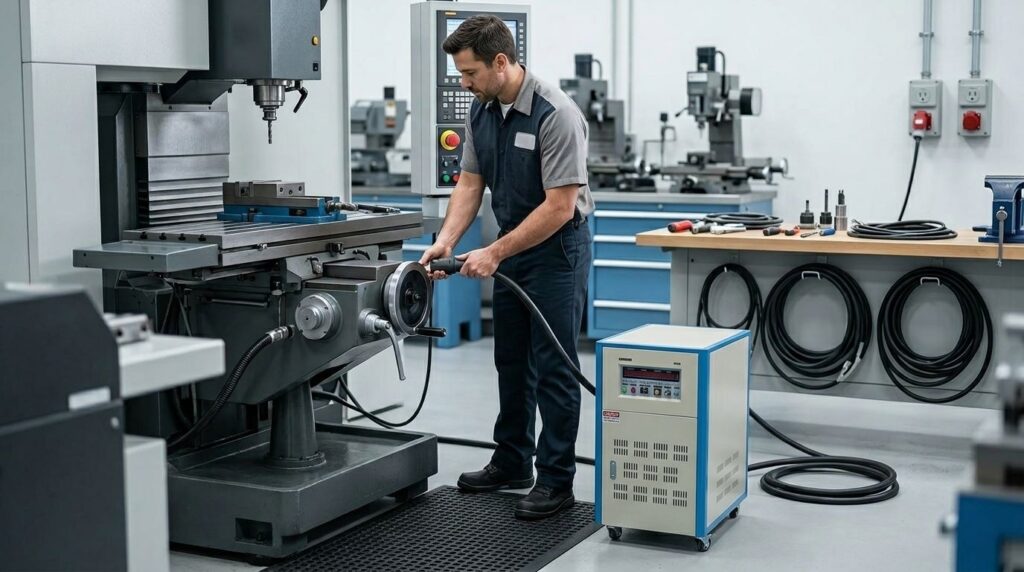
A single phase frequency converter acts as an intelligent power bridge between the local grid and your imported equipment. It takes in the power your facility provides and outputs precisely the voltage and frequency your machine requires — cleanly and safely.
Converts Voltage and Frequency Simultaneously
A quality single-phase converter handles both voltage and frequency adjustment in one unit. For example, it can accept 120V/60Hz from a US wall outlet and deliver 220V/50Hz to your imported European machine. This dual conversion is essential — addressing only one parameter while ignoring the other still leaves your equipment at risk.
Protects Equipment from Power-Related Damage
Beyond conversion, a well-designed frequency converter provides stable, clean output power. It buffers your equipment from common grid issues including voltage spikes, harmonic distortion, and fluctuations. This protection is particularly valuable in industrial environments where power quality can vary significantly throughout the day.
Enables a Controlled Soft-Start
Many single phase frequency converters include soft-start functionality, which gradually ramps up power when the machine is switched on. This reduces the inrush current that occurs at startup — one of the most stressful events for motors and electronics. Soft-start capability not only protects the machine but also reduces the risk of tripping circuit breakers in your facility.
Key Benefits of Using a Single Phase Frequency Converter
For businesses dealing with imported equipment, a frequency converter offers advantages that go well beyond simply making a machine turn on:
- Keeps imported machines working in the US: Eliminates compatibility barriers so you can deploy equipment regardless of the country it was manufactured in.
- Reduces downtime and repair costs: Power-related failures can be expensive and difficult to diagnose. A converter prevents those failures from happening in the first place.
- Extends machine lifespan: Consistent, correctly-specified power reduces thermal and electrical stress on motors, windings, and control boards, helping equipment last years longer.
- Protects your investment: With high-value imported equipment costing tens of thousands of dollars, a converter that costs a fraction of that price provides critical insurance.
- Supports stable industrial operations: Production schedules don’t accommodate unexpected equipment failures. A converter keeps your operations running on time.
How to Choose the Right Single-Phase Frequency Converter
Not all converters are created equal, and choosing the wrong unit can be just as damaging as having no converter at all. Here’s what to evaluate before purchasing:
Power Capacity (Load Requirements)
The frequency converter must be rated to handle your machine’s full power draw, including startup surges. As a general rule, size the converter at 1.5 to 2 times the machine’s rated wattage to safely accommodate inrush current at startup. An undersized frequency converter will overheat, trip, or fail prematurely under peak load.
Input/Output Voltage Compatibility
Verify both the input voltage available at your facility and the output voltage your machine requires. Common US input options are 120V single-phase or 240V single-phase. Confirm the converter can accept your available supply and deliver the precise output your equipment specifies — even small deviations matter for sensitive electronics.
Continuous vs. Peak Load Handling
Some machines run at a steady load — think fans, pumps, or lighting systems. Others cycle between low idle states and high-demand bursts, like compressors, welding equipment, or injection molding machines. Make sure the frequency converter’s peak load rating matches your worst-case scenario, not just the average operating load.
Output Waveform Quality
For sensitive equipment — CNC controllers, medical devices, lab instruments — the quality of the output waveform matters. Look for single phase frequency converters that produce a pure sine wave output rather than a modified sine wave. Pure sine wave output closely mimics utility power, ensuring compatible equipment runs without errors, overheating, or noise.
Adjustable Output Voltage
A significant advantage of modern single-phase frequency converters is adjustable output voltage, typically ranging from 0 to 300V. This flexibility means a single converter can serve multiple machines with different voltage requirements — without rewiring or buying separate units. It also allows fine-tuning for equipment that performs best at a specific voltage within a range, rather than a fixed nominal value.
Safety Protections and Compliance
In a professional or industrial setting, look for single phase frequency converters with built-in overload, short-circuit, over-temperature, and power failure protection. These safeguards are essential not just for equipment protection, but for workplace safety and insurance compliance. Cutting corners on a cheap, unprotected unit can void warranties on the equipment it powers and create serious liability risks.
Conclusion
The frustration of imported equipment that won’t run is a solvable problem — and you shouldn’t have to replace perfectly good machines just because of an electrical standards mismatch. A single-phase frequency converter is a straightforward, cost-effective solution that handles voltage and frequency differences so your equipment can perform exactly as intended on US power.
Whether you’re setting up a single piece of German woodworking equipment in a small shop or deploying a line of Japanese industrial machines in a large facility, getting the power right from day one protects your investment, keeps production on schedule, and extends the working life of your equipment for years to come.