

For most of the last five years, the standard complaint about dollar tokens on Ethereum was the toll booth. Sending a few hundred dollars of stablecoin and paying twelve for the privilege made the whole proposition look silly to anyone who had ever used a bank transfer.
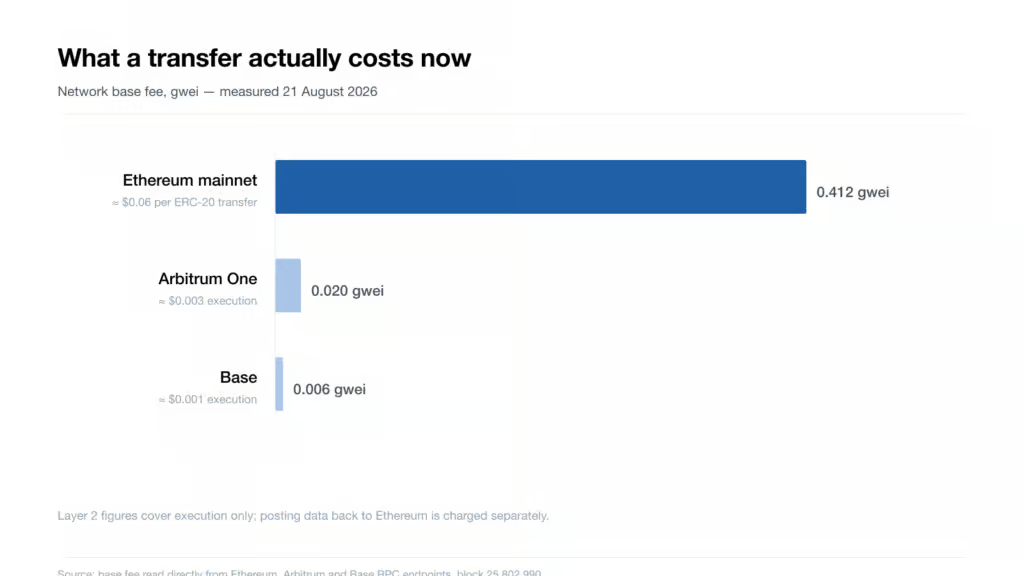
Base fees read directly from each network at block 25,802,990. Layer 2 figures cover execution only.
That argument has quietly stopped working. At block 25,802,990 on August 21, 2026, Ethereum’s base fee was sitting at 0.41 gwei. A standard ERC-20 transfer consumes roughly 63,000 gas units, which puts the cost of moving USDT on mainnet at about six cents at an ether price near $2,400. On Arbitrum the base fee at the same moment was 0.02 gwei; on Base, 0.006. Layer 2 execution has become close to free, with only the data-availability charge for posting to Ethereum left to pay. And the float being moved is not small: Tether’s own transparency page puts USDT outstanding in the region of $183 billion, which makes it larger than most national money-market funds and comfortably the most-transferred dollar instrument in crypto.
Transfer USDT to a trading venue, a payroll provider or a counterparty today and the cost question is close to settled. What replaces it is the set of questions gas fees were conveniently distracting everyone from. Whether the destination is a platform where you keep custody of the balance or one where you hand it over, the network fee is no longer the variable deciding the outcome.
1. The rail you pick decides more than the price
Cheap does not mean equivalent. From an operational standpoint, USDT balances on Tron, Ethereum, Arbitrum, and Base are four distinct assets, even though they share the same ticker and price.
They differ on three axes that matter to a finance team:
- Finality. How long before the transfer is economically irreversible, and under what assumptions. Rollups inherit Ethereum’s security, but the withdrawal path back to mainnet carries its own timing rules, and optimistic rollups in particular hold a challenge window that a treasury process has to account for.
- Reachability. Not every counterparty supports every network. Sending to an address on a chain the recipient does not index is the most common way to lose a stablecoin balance, and no amount of cheap gas protects you from it.
- Reversal by the issuer. Tether can freeze addresses. That is a feature if you are a compliance officer and a risk if you are a treasurer, and it applies regardless of which chain the tokens sit on.
2. A dollar token is not a bank deposit
This is the part the fintech press tends to underplay. The Bank for International Settlements published a bulletin in 2023 arguing that stablecoins, because they circulate as bearer instruments rather than settling in central bank money, can drift away from par in a way tokenized deposits do not. The authors framed it as a challenge to the “singleness of money,” which is economist-speak for the assumption that a dollar is a dollar wherever it happens to sit.
In practice that means three things.
First, redemption is a commercial relationship with an issuer, not a legal claim on a central bank. Second, the peg is an empirical result rather than a guarantee, and it has broken before under stress for several large stablecoins. Third, the secondary market price is where the strain shows up first. If you are treating a stablecoin balance as cash equivalent on a balance sheet, that distinction eventually matters to an auditor.
None of this makes stablecoins unusable. It makes them an instrument with counterparty risk, priced and monitored accordingly.
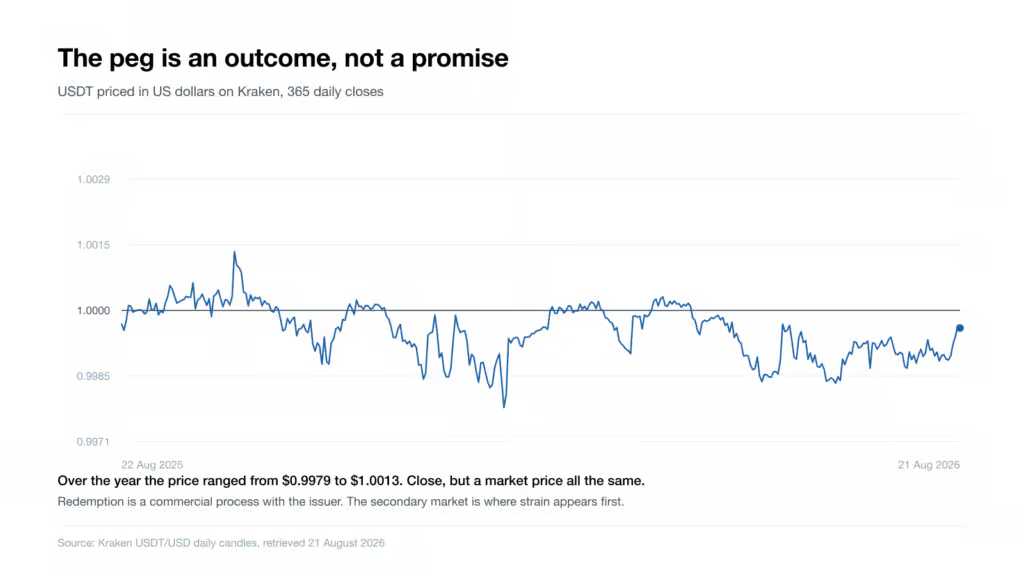
A year of daily closes on Kraken. The deviations are small, but they are deviations, and they are set by a market rather than by a guarantee.
3. What the low fee environment actually changed
Three shifts are worth tracking, because they alter business models rather than just spreadsheets.
- Micro-settlement became viable. At six cents on mainnet and a fraction of a cent on a rollup, per-invoice or per-transaction settlement stops being absurd. Remittance corridors and creator payouts are the obvious cases; B2B netting is the less obvious one.
- Collateral moves faster than it used to. Traders shifting margin between venues used to time transfers around gas spikes. That constraint is largely gone. Transfer USDT to a venue that accepts stablecoin deposits and the margin is usable in minutes rather than whenever the network made the move affordable, which compresses the response time of the whole market and, incidentally, makes liquidation cascades faster too.
- The cost of holding stopped being the cost of moving. With transfer fees near zero, the meaningful expense is now spread, slippage and, on derivatives venues, funding. A trader paying 0.03 percent in daily funding on a leveraged position is spending several orders of magnitude more per day than the transfer that funded it.
4. The compliance layer did not get cheaper
Cheap rails have not made the regulatory question go away, and the direction of travel is clear enough. The Financial Stability Board’s global framework for crypto-asset activities set out recommendations covering both crypto-asset markets generally and global stablecoin arrangements specifically, and national regulators have been implementing versions of it ever since.
For anyone building on stablecoin rails, the practical consequence is that the expensive part of a transfer is no longer computed in gwei. It is the sanctions screening, the travel-rule messaging, the record retention and the jurisdictional analysis of who your counterparty is. Those costs scale with volume and headcount, not with network congestion.
A quick side-by-side of the two instruments
| Stablecoin balance | Bank deposit | |
| Issuer | A private company | A licensed bank |
| Your claim | Contractual, against the issuer | A deposit liability under prudential rules |
| Redemption | A commercial process, not guaranteed | At par, on demand |
| Can be frozen | Yes, by the issuer at the token level | Yes, by court or regulatory order |
| Deposit insurance | None | Up to statutory limits |
What to check before you move size
- Confirm the destination chain with the recipient in writing, every time, including the token contract address.
- Test with a small amount first. The cost of a failed test transfer is now genuinely trivial, which removes the last excuse for skipping it.
- Watch the base fee, not the wallet’s default estimate. Mainnet at 0.41 gwei and mainnet at 40 gwei are different products, and the second one still happens.
- Separate transfer cost from trading cost when you model a strategy. They are usually off by two or three orders of magnitude, and people conflate them constantly.
- Treat issuer risk as a real line item, with a documented view on what happens if a balance is frozen.
The interesting thing about stablecoin transfers in 2026 is not that they are cheap. It is that once the fee stops being the story, everything you were ignoring while you complained about gas is still sitting there waiting.
Fee data read directly from Ethereum, Arbitrum and Base RPC endpoints on August 21, 2026. Ether price approximately $2,396 at time of writing.