

Digital payments sit at the core of the modern economy, yet not all industries enjoy equal access to financial infrastructure. Sectors categorized as “high risk” — including online gaming, digital entertainment, and other cross-border services — often face restrictive banking policies, delayed settlements, and persistent exposure to chargebacks. These constraints shape not only how businesses operate, but also how users interact with digital platforms.
In recent years, Ethereum-based payments have emerged as an alternative settlement layer for these industries. The growing relevance of a comprehensive resource on Ethereum gambling platforms reflects a broader shift toward crypto-enabled payment models that prioritize speed, finality, and operational resilience. Rather than replacing traditional finance, these systems operate alongside it, addressing structural inefficiencies where conventional banking falls short.
Limitations of traditional banking in high-risk digital sectors
Traditional banking infrastructure was not designed for industries characterized by global reach, instant interaction, and high transaction frequency. High-risk digital sectors often encounter account freezes, payment delays, and elevated processing fees due to compliance burdens and chargeback exposure.
Chargebacks represent a particularly acute issue. In card-based systems, payments can be reversed weeks or even months after a transaction occurs, creating uncertainty for operators and increasing fraud-related costs. For industries with digital delivery and immediate consumption, this asymmetry between payment finality and service delivery poses a fundamental mismatch.

Moreover, cross-border operations introduce additional friction. Currency conversion, correspondent banking relationships, and regional compliance requirements slow settlement and fragment liquidity. For digital-native platforms operating globally, these constraints undermine scalability.
From a systemic perspective, these inefficiencies are not merely operational inconveniences. They reflect structural limitations within existing payment architectures. Analysis on the evolution of the global monetary system and its future payment layers highlights how legacy systems struggle to accommodate emerging digital business models that demand real-time settlement and global interoperability.
Instant settlement and operational efficiency with Ethereum
Ethereum-based payments address several of these constraints by design. Transactions settle directly on-chain, without intermediaries, and achieve finality once confirmed by the network. This eliminates chargeback risk and provides immediate certainty to both parties.
For operators, instant settlement improves cash flow predictability and reduces the need for costly risk mitigation strategies. Funds received are immediately available for reinvestment, liquidity management, or operational expenses. This is particularly relevant in industries with high transaction velocity, where delays compound inefficiencies.
From a technical standpoint, Ethereum’s programmability further enhances operational efficiency. Smart contracts automate settlement conditions, enforce rules transparently, and reduce reliance on manual reconciliation. This lowers overhead and minimizes points of failure inherent in fragmented payment pipelines.
For users, the experience is equally transformed. Payments are executed directly from personal wallets, without exposing sensitive banking information. This reduces dependency on centralized processors and enhances privacy while maintaining transparency through public verification.
Importantly, these advantages are not theoretical. They are already being leveraged by platforms operating in environments where traditional banking access is limited or unreliable. Ethereum’s role in these contexts is less about ideological decentralization and more about functional efficiency.
Regulatory considerations for crypto-based payments
Despite their operational advantages, crypto-based payment systems operate within an evolving regulatory landscape. Policymakers and international bodies increasingly recognize that virtual assets play a material role in financial flows, particularly in sectors underserved by traditional banking.
Regulatory focus has centered on anti-money laundering (AML), counter-terrorism financing (CTF), and consumer protection. Guidance on virtual assets and virtual asset service providers outlines the expectations placed on entities facilitating crypto transactions, emphasizing risk-based approaches rather than blanket prohibitions.
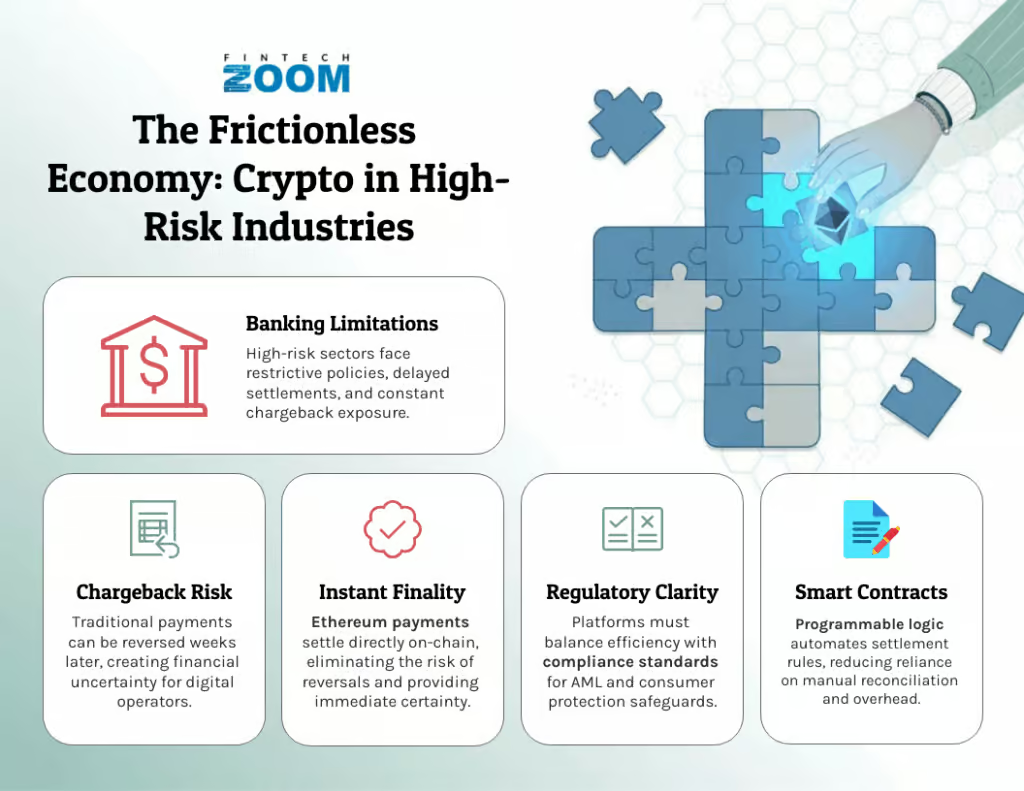
For high-risk digital industries, this regulatory clarity is essential. Platforms integrating Ethereum payments must balance efficiency with compliance, ensuring transparency, traceability, and appropriate safeguards. While decentralization reduces reliance on intermediaries, it does not eliminate regulatory responsibility.
At the same time, crypto payments offer regulators improved auditability. On-chain transactions create immutable records, enabling more effective monitoring compared to opaque legacy systems. This paradox — increased transparency through decentralized infrastructure — challenges assumptions that crypto inherently undermines oversight.
The trajectory suggests convergence rather than conflict. As regulatory frameworks mature, Ethereum-based payment models are increasingly positioned as complementary components of the financial ecosystem, particularly where traditional systems impose disproportionate friction.
Redefining payment logic in digital industries
The adoption of Ethereum payments represents a broader rethinking of payment logic in digital industries. Instead of retrofitting legacy systems to new use cases, platforms are adopting infrastructure aligned with digital-native requirements: instant settlement, global reach, and programmable logic.
This shift does not imply the obsolescence of traditional banking. Rather, it reflects specialization. Conventional systems remain well-suited to low-risk, domestic transactions, while blockchain-based payments address niches where speed, finality, and interoperability are paramount.
For fintech observers, the key insight lies in how these systems coexist. Ethereum’s growing role in high-risk sectors demonstrates how alternative payment rails can alleviate systemic bottlenecks without displacing existing financial institutions entirely.
Toward a frictionless digital economy
As digital industries continue to expand, the demand for efficient, reliable payment infrastructure will intensify. High-risk sectors, often first to encounter systemic friction, serve as testing grounds for new models of value transfer.
Ethereum-based payments illustrate how crypto infrastructure can function as a pragmatic solution rather than a disruptive ideology. By reducing friction, eliminating chargebacks, and enabling instant settlement, these systems reshape operational dynamics where traditional banking struggles to adapt.
The evolution toward a frictionless economy will not be linear, nor uniform across sectors. However, the growing integration of Ethereum payments into high-risk digital industries suggests that blockchain-based settlement is moving from the margins toward functional relevance within the global financial landscape.