

Since 2021, compliance has taken a steadily larger share of what young fintechs earn, rising from about 7% of revenue to nearly 10% by 2025 at companies with $5 million to $25 million in sales. For founders who build a consumer fintech to $15 million in annual revenue, that usually means three of their 40 or so employees spend all of their time on compliance, while they also pay for identity checks on every customer they onboard, for monitoring software that screens each transfer, and for the yearly audit their partner bank requires as a condition of the relationship. Added up, that comes to roughly $1.38 million a year, which is the median compliance spend for fintechs with $5 million to $25 million in revenue, and costs at companies of that size rose a median 12% over 2025.
Small fintechs carry the heaviest burden
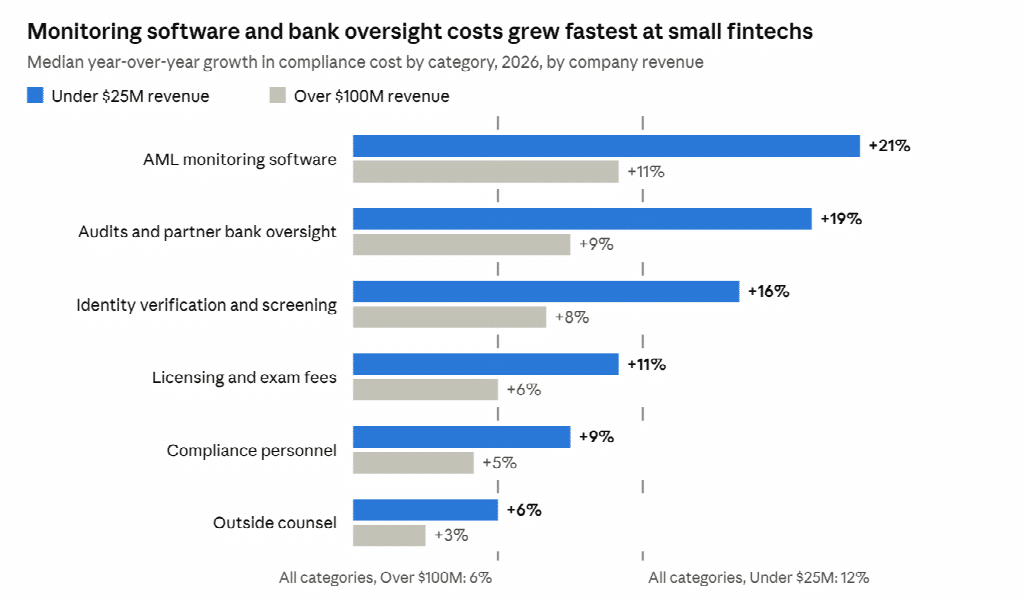
A compliance program costs much the same whether a fintech earns $3 million a year or $300 million, so companies under $5 million in revenue spend 14.2% of it on compliance, while those above $500 million spend 2.4%. That gap widened this year, with costs at companies under $25 million growing at twice the 6% pace recorded at firms above $100 million.
Software and audit costs are rising twice as fast as payroll
At companies under $25 million in revenue, spending on AML transaction monitoring software rose 21% this year and the cost of audits and partner bank oversight rose 19%, more than twice the 9% growth in compliance payroll. Staff still account for 46% of compliance spending, in line with what LexisNexis Risk Solutions has found across the wider financial industry, where labor is the largest part of a financial crime compliance bill it estimated at $61 billion a year in the U.S. and Canada.
Source: 2026 survey of 286 U.S. fintech companies
Sponsor banks are driving the fastest-growing costs
Both of the fastest-growing categories trace back to the sponsor banks that fintechs depend on. Under the Bank Secrecy Act, the bank is responsible for customer due diligence and transaction monitoring, so it writes those duties into its partner contracts and has the fintech pay for the audits that check the work. Banks have applied that oversight far more strictly since Synapse collapsed in 2024 and left customer deposits frozen at its partner banks.
Neobanks and banking-as-a-service programs, which operate under a partner bank’s charter and hold a median of just four licenses, still spend 10.9% of revenue on compliance. Nearly a quarter of them have worked through a regulatory order or remediation plan in the past three years, the highest share of any segment in the study.
Compliance’s share of revenue fell for the first time
Spending on software has also kept the overall burden from growing as fast as the dollar figures suggest. Among fintechs with $5 million to $25 million in sales, compliance fell to 9.6% of revenue in 2026 from 9.9% the year before, the first decline in the six years the data covers, as revenue outgrew compliance budgets and firms automated work they might otherwise have hired for. That easing follows a rise of almost three percentage points between 2021 and 2025, however, and it has done little to slow the growth in what these companies actually pay.
Federal deregulation has not lowered the bill yet
All of this happened in a year when federal policy was moving in the opposite direction. In April, FinCEN proposed rewriting AML program rules around effectiveness rather than technical compliance, with significant enforcement generally reserved for institutions that never set up a program or fail systemically in running one. On May 19, President Trump signed an executive order giving the CFPB, OCC, FDIC and other regulators 90 days to identify rules and supervisory practices that get in the way of bank-fintech partnerships.
None of these changes has reduced what a fintech spends so far, since the FinCEN rule would take effect only 12 months after it is finalized and leaves the basic structure of AML obligations in place. The OCC was also still publishing BSA consent orders against small banks this spring, including one against a federal savings association in the Northeast, and a sponsor bank that has watched its peers face enforcement over their fintech programs is unlikely to scale back its audits while a federal review is under way.
The partner bank contract now sets compliance costs
That leaves the fastest-growing costs largely outside a fintech’s control, with vendors setting the price of monitoring software and banks deciding how much auditing a program needs. In practice, the most important negotiation over compliance spending now takes place when a fintech signs its partnership agreement, and founders who read that contract for its compliance terms as carefully as its pricing will have a far better sense of what 2027 is likely to cost them.