

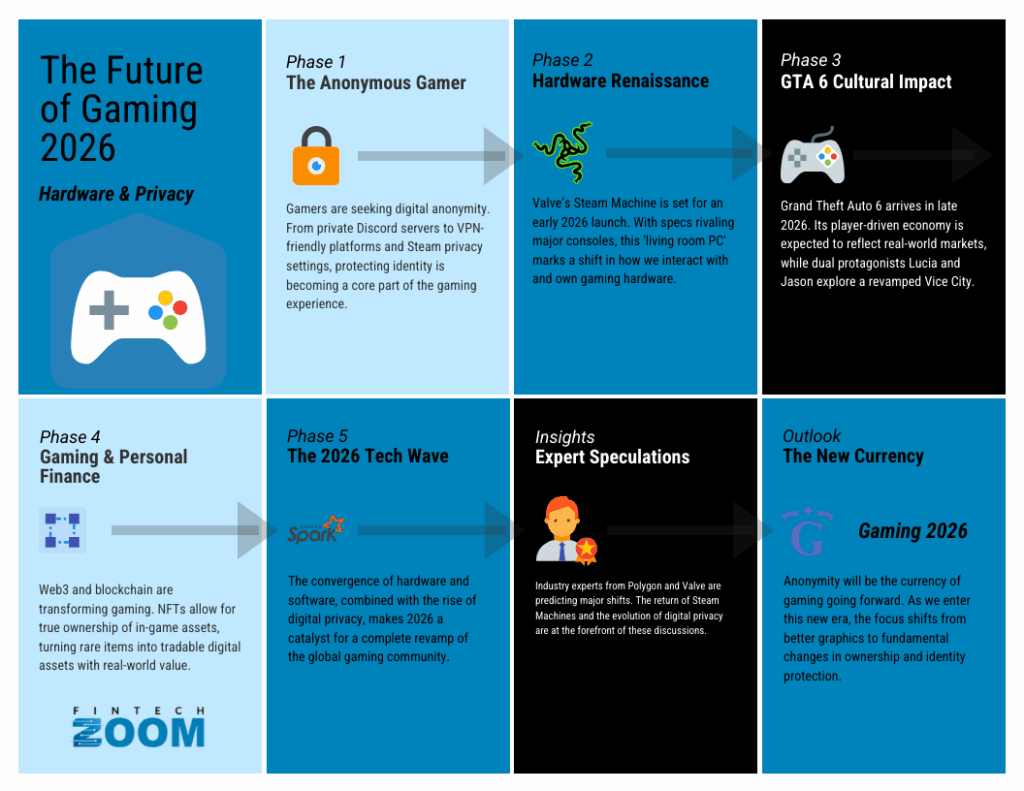
Currently, industry experts have begun their speculations on where the gaming sector is headed in 2026, and major predictions have surfaced from large players like Polygon. From the return of Steam Machines to GTA 6 and the growing need for privacy, 2026 is looking to be a year of major developments for the global gaming community. This shift is not just about better graphics, but more a fundamental transition in the way we interact with hardware, how we own it, and the way we protect our identities online.
The Anonymous Gamer: Privacy in a Connected World
There has been a major trend among gamers who wish to keep their digital personas completely separated from their real-world identities. Of course, this is indicative of a much deeper-running phenomenon surrounding anonymity in the modern gaming world. For example, there has been a rise in private gaming servers and encrypted accounts within gaming communities, and this is happening on a large scale, at a rapid pace.
One place this can be seen is on Discord, with many gamers creating specific handles and private communities to control data sharing. These are no longer just channels for game chats, but actual private servers to keep unwanted guests out. On the broader gaming spectrum, online casinos have even leaned into this trend, with these platforms standing at the forefront of privacy.
Specifically, anonymous casino platforms skip any ID checks (as these delay withdrawals), allow for instant crypto deposits, and are VPN-friendly for added privacy. These casinos are set up using secure payment gateways that protect sensitive banking information and allow users peace of mind to keep playing games. Even Steam (and other major gaming platforms) have followed suit, providing gamers the option to keep their profiles private. This means only select (if any) people can view their library and playtime data.
Hardware Renaissance: The 2026 Steam Machine
As it stands, the Steam Machine already rivals major consoles such as Xbox and PlayStation, which have been in the game for decades. Although Steam is known for being a PC gaming platform, it surprised gamers globally with its announcement of a living room PC that can be used for gaming. While it has been a long time coming that Valve would create a PC native to their system, it was shocking to see them come out with a design for a glorified console.
While there is no current release date confirmed, Valve has promised an early 2026 launch, which gives little room for speculation other than a potential Q1 market appearance. Despite there being no clear launch or price point for the device, there are already talks of a Steam Machine 2. While nothing has been officially confirmed, netizens are buzzing with what this upgraded device could look like.
For one, hardware is a major point of discussion. Will Valve follow the approach they had with the Steam Deck? After the release of the initial model, a second option was made available, wherein the core components were kept the same, but some major peripheral changes (OLED screen versus LCD and bigger storage capacity) were made. The much-anticipated Steam Machine is expected to have a semi-custom AMD Zen 4 CPU and AMD RDNA 3 GPU alongside unified 8GB GDDR6 and 16GB DDR5 RAM. Will an upgraded device keep these specs, or completely change the design?
GTA 6 and the Cultural Economy
Grand Theft Auto 6 is more than just a game title. Rather, it is a massive, highly anticipated AAA game that has finally seen a launch date announcement after years of fans waiting. Now that the game’s release has been confirmed for November 2026, gamers and experts alike have been speculating on what can be expected from this long-awaited installment to the franchise.
For one, many predictions have surfaced surrounding the in-game economy and how it could potentially reflect real-world developments. This would not be the first time such a phenomenon occurs, with World of Warcraft seeing a similar trend with the implementation of AI-driven algorithms. WoW is also a good example of how the in-game economy is player-driven. In light of this, there is a high possibility that GTA 6 might see a similar pattern, with its economy reflecting real-world markets or inflation.
Specifically, the impact that player supply and demand have on the game could see fluctuations similar to those of WoW. Beyond this, fans are predicting amazing visuals as players return to Vice City as Lucia and Jason (dual protagonists). One of the more exciting changes is the revamped weapon system and the breathing room allowed for deeper interactions with the environment. One look at the GTA 6 trailers, and the huge hype makes sense.
The Intersection of Gaming and Personal Finance
From a financial standpoint, the gaming economy is finally gaining some stability, especially where Play-to-Earn and similar digital asset models are concerned. Previously, gaming systems were pretty straightforward: you play, you win, and if you pay, you win even faster. The introduction of new technology, such as blockchain, has been a complete game-changer (pun intended) in that gamers can become digital asset managers just by playing.
For instance, the presence of Web3 technology in gaming makes use of blockchain to ensure that a player gains true ownership of the assets they acquire in-game. Win a rare skin, or unlock a sought-after weapon? Web3 tech will use NFTs (Non-Fungible Tokens) to turn these into items that can be traded or sold (basically giving them real-world utility and not just in-game value).
Naturally, this will impact the way players approach gaming. More gamers will be willing to grind for in-game items, as their time and dedication are rewarded with real-world value. This can also see the emergence of more official platforms that allow for such items to be traded. In turn, a whole new branch of the gaming world is expected to form by the end of 2026.
Preparing for the 2026 Tech Wave
Of course, these are just some of the major predictions floating around the gaming communities as we enter 2026. The Steam Machines and GTA 6 especially play prominent roles, as they showcase how hardware and software are converging. Throw privacy into the mix, and anonymity will be the currency of gaming going forward. Ultimately, 2026 is looking to be an era for change; a catalyst for a complete revamp to gaming as we know it.