

The CFD trading experience can feel unintentionally hostile to new or casual participants. Even when someone understands the general idea-trade price movements without owning the underlying asset-the practical experience often becomes confusing fast: leverage and margin mechanics feel abstract, costs are not always intuitive, and the platform’s interface can overwhelm rather than guide.
So when a platform claims to simplify the experience for everyday traders, the question shouldn’t be “is it easy?” The better question is: does it help traders make fewer mechanical mistakes and maintain clearer control over risk?
Why simplification matters in leveraged trading
In leveraged products, small misunderstandings compound quickly. The most common beginner issues are not exotic-they’re basic:
- entering the wrong position size,
- trading without a stop-loss,
- not understanding margin usage,
- and underestimating how costs (spreads and overnight fees) affect performance.
A simplified platform experience helps reduce those errors by making key information visible earlier in the process and by making the “correct” actions easier to do consistently.
What “simplify” should mean (and what it shouldn’t)
Good simplification is structural. Bad simplification is cosmetic.
Good simplification improves clarity while preserving important details: cost visibility, risk metrics, order sizing, and position management.
Bad simplification hides complexity until after the trade is open-when the trader is emotionally involved and more likely to react poorly.
Everyday traders benefit most when simplification lowers cognitive load without removing the information that prevents mistakes.
Common areas where platforms improve the everyday experience
A platform focused on everyday usability usually works on a few predictable areas:
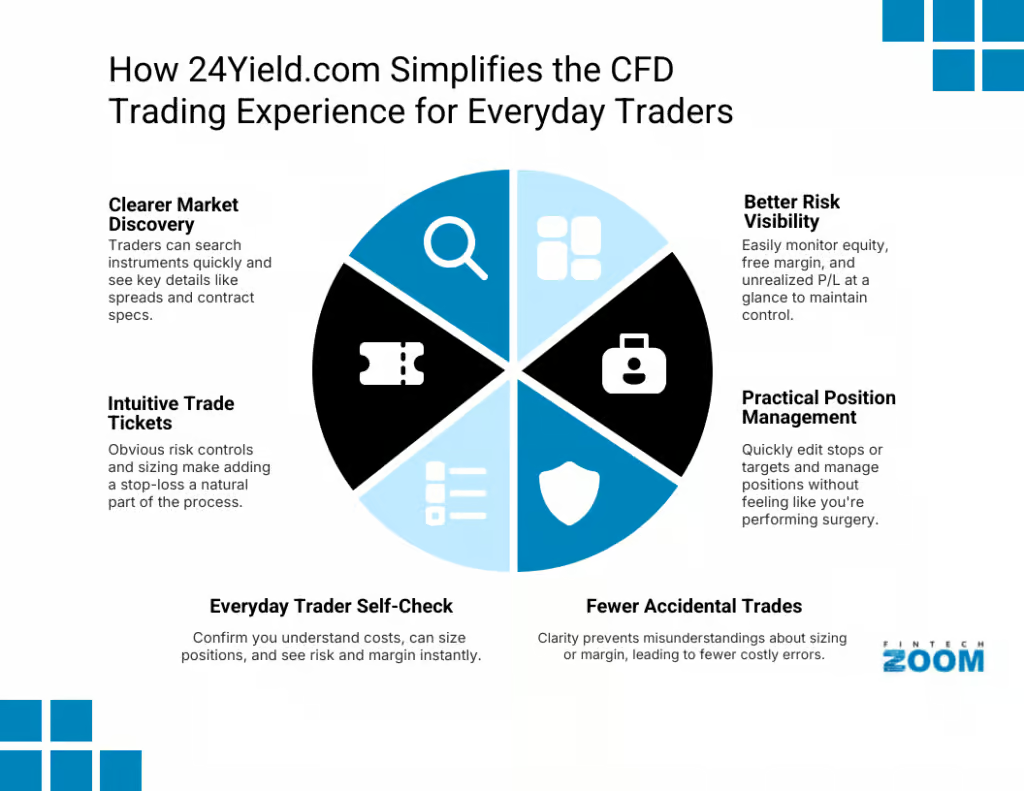
1) Clearer market discovery
Traders should be able to search instruments quickly, understand what they’re selecting, and see key details that influence execution (hours, typical spread behavior, and contract specs).
2) More intuitive trade tickets
The trade ticket is the moment of truth. It should make sizing and risk controls obvious, not buried. If adding a stop-loss feels like extra work, many beginners skip it-often until they learn the lesson the expensive way.
3) Better “at-a-glance” risk visibility
The platform should make it easy to see equity, free margin, open exposure, and unrealized P/L. That’s not “advanced.” That’s survival.
4) Practical position management
Everyday traders need quick editing of stops/targets, clear display of average entry, and the ability to manage positions without feeling like they’re performing surgery.
The practical value: fewer “accidental trades”
One of the biggest advantages of a well-designed platform is that it reduces “accidental trading”-situations where a trader didn’t intend to take that level of risk but did so because the interface made it easy to misunderstand sizing or margin.
What is margin you might ask? This article will help you to understand Margin Trading.
Here’s a small example of what simplification looks like when it’s done properly:
- The platform clearly shows margin impact before execution.
- It nudges, but doesn’t force, stop-loss usage.
- It surfaces key costs and risk metrics without menu hunting.
That combination reduces avoidable errors while still leaving strategic choices in the trader’s hands.
If you want a snapshot of public user sentiment and how people describe their experience, you can review 24yield review and compare it against your own checklist around clarity, cost visibility, and risk control.
A short “everyday trader” self-check
If you want to evaluate whether a platform truly simplifies the experience, ask yourself:
- Do I understand what I’m paying for each trade (and for holding)?
- Can I size positions confidently without guessing?
- Can I see risk and margin instantly?
- Can I exit or adjust quickly without confusion?
If the answer is consistently “yes,” then the platform isn’t just friendly-it’s operationally helpful.
You can find the 24Yield mobile app in:
- 24 Yield App for iOS
- 24 Yield App in Google Play
Final take
The ideal simplified CFD experience does not remove important information; it reorganizes it so traders see what matters when it matters. That tends to lower mistakes, improve consistency, and make learning less painful. But the trader still has to bring discipline. A smooth platform cannot compensate for overtrading, poor risk control, or emotional decisions-it can only make good habits easier to execute.