

“Up to US$4 million” is a ceiling for the largest enterprise datasets, not a typical or guaranteed payout. Here is what turns it into cash.
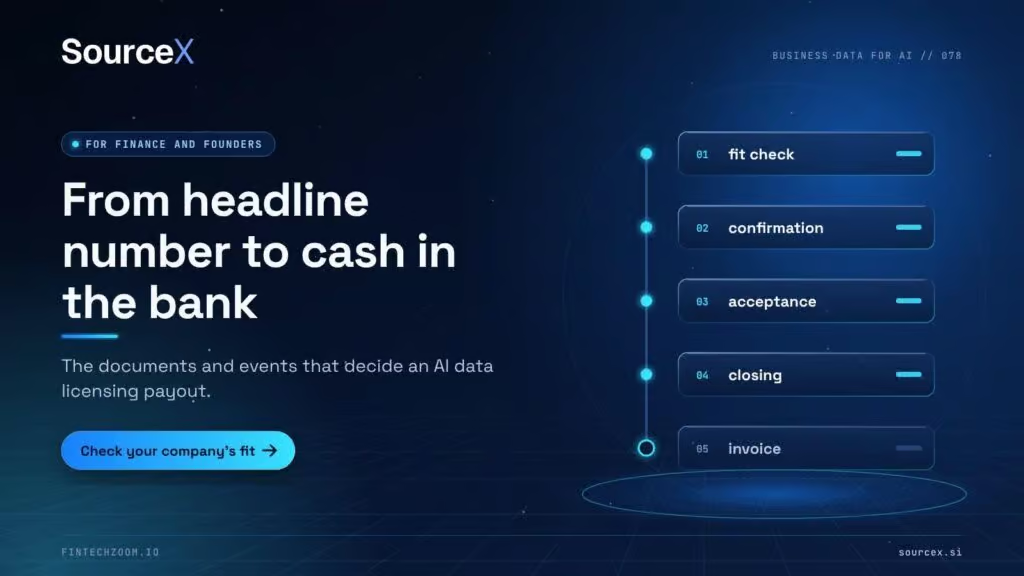
“Up to US$4 million” is a ceiling for the largest enterprise datasets, not a typical or guaranteed payout. Here is what turns it into cash.
Every CFO has a private category for money that has been mentioned but not contracted. It sits somewhere between “pipeline” and “wishful thinking,” and it never goes in the cash-flow forecast.
So when a business owner sees an advertised payout ceiling for licensing company data, the useful reaction isn’t excitement or dismissal. It’s a finance question: which document fixes the number, and which event makes it payable?
THE SHORT VERSION
- An advertised maximum is a ceiling for the largest datasets. Your payout depends on your specific records, rights and signed terms.
- The Confirmation fixes the agreed price; written acceptance and Closing permit invoicing, and the signed invoice terms determine when payment is due.
- Licensing rights can outlive the payment, so review them alongside the money.
Start with what is being licensed
A payout is the price of a specific collection for a specific use, not a valuation of your archive.
Support cases, engineering histories, CRM records and internal documents can all be candidates. Their usefulness depends on the task they can support and whether they preserve context, such as what was asked, what was done and what happened next.
Then reality applies its discounts. Duplicates shrink the real case count. Missing outcomes reduce usefulness. Third-party or restricted material may have to be carved out entirely. Company size helps describe scale, but there is no universal price per employee, gigabyte or row.
How much can a company really earn?
SourceX, which licenses approved business records directly from companies for AI training and evaluation, advertises payouts of up to US$4 million. It describes that figure as an indicative upper bound for the largest enterprise datasets, not a typical or guaranteed outcome.
That is a fair way to read any headline in this market: a ceiling, not a forecast for your business. SourceX looks first at companies with a peak headcount of at least 50 full-time employees and several years of operating history, and even qualifying does not guarantee an offer.
A signed price is only one part of a deal. Finance also needs the acceptance conditions and the event that starts the payment clock.
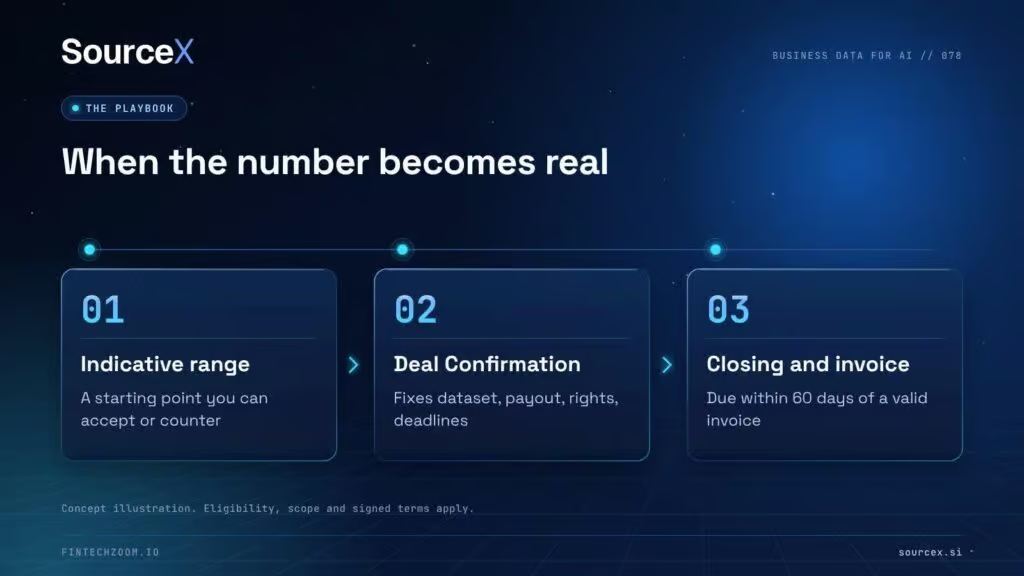
When the number becomes real: Indicative range, Deal Confirmation, Closing and invoice. Concept illustration, not measured performance or a completed transaction.
When does a number become a commitment?
Follow the paperwork. In SourceX’s published process, the economics firm up in stages:
- Indicative offer. A proposed price range, which the company can accept or counter. It stays indicative.
- Master agreement. One master supplier licensing agreement sets the framework.
- Dataset Deal Confirmation. A short, per-deal document signed by both sides that fixes the exact dataset, the payout, the rights and the deadlines. Finance can model that price together with its acceptance and Closing conditions, rather than treating signing as cash received or automatic revenue recognition.
The company signs with SourceX rather than with an AI developer, and SourceX runs the agreement, preparation and payment under those signed terms. Until signing, the company can walk away at no cost.
What has to happen before you can invoice?
Signing the Confirmation fixes the price. It does not make it payable.
The data is then prepared and delivered, and SourceX reviews it for up to 30 days from the review-start event set in the Confirmation. Closing follows written acceptance and the applicable conditions being met, and the company receives a Closing Notice.
Only then does the company invoice. Under standard terms, payment is due within 60 calendar days after SourceX receives a valid invoice, unless different terms are signed. The fee is usually one-time, with no royalties.
The downside case matters too. Under the standard terms, data that has not closed by the deadline is treated as declined and earns no payment. SourceX destroys its copies within 30 days, subject to the stated retention processes and applicable law. Model both branches.
Don’t confuse two payment clocks
If someone introduced your company through a referral program, their reward runs on separate conditions and a separate timetable. A supplier’s “net 60 after invoice” is not a shortcut for when a connector gets paid, and vice versa.
Use each party’s signed arrangement, with its trigger event, rather than a loose “net sixty” in a spreadsheet note.
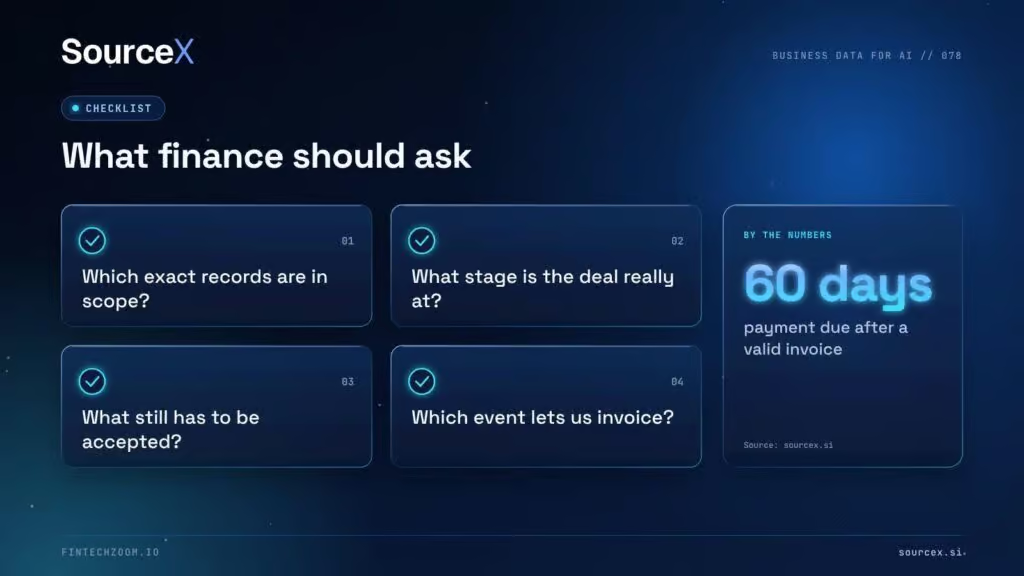
What finance should ask. Four takeaways from the article; the text supplies the full context and conditions.
The rights side of the ledger
Price is half the deal. SourceX’s public materials describe the company keeping ownership of its original data, granting exclusivity over the selected data for AI training for the term set in the Confirmation, and a license to the de-identified dataset that becomes permanent once the fee is paid. The agreement does not require SourceX or its customers to untrain or stop operating models already built from it.
A one-time payment can therefore come with long-lived rights. Weigh those against future internal AI plans and other licensing options, and count your team’s preparation time as a real cost when you calculate the net benefit. The signed agreement controls in every case.
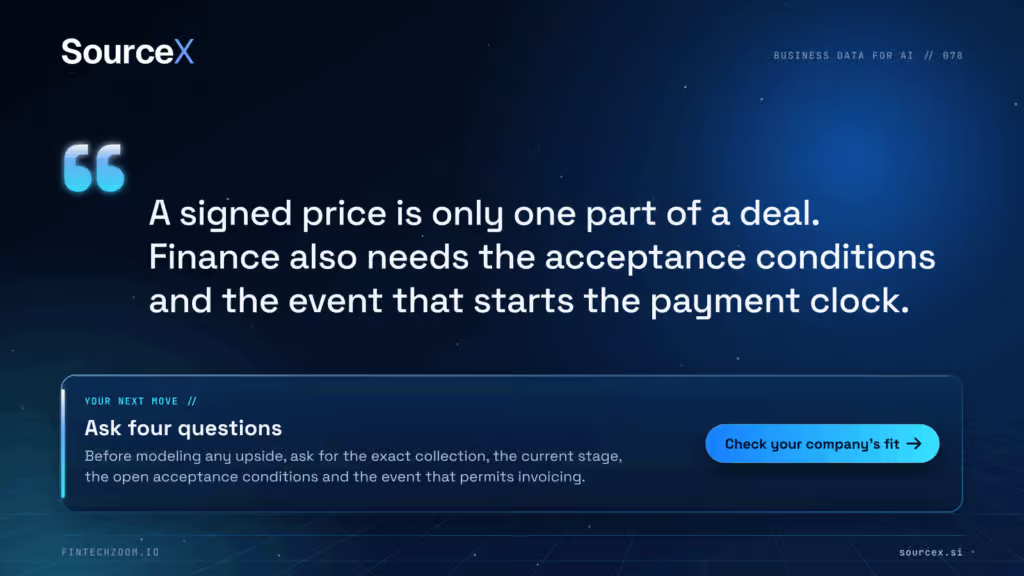
Ask four questions. Before modeling any upside, ask for the exact collection, the current stage, the open acceptance conditions and the event that permits invoicing.
Four questions to ask first
Before anyone models upside, ask:
- Which exact records are in scope?
- What stage is the deal really at?
- Which acceptance conditions remain open?
- Which event permits us to invoice?
Those answers turn a marketing headline into a commercial proposition your business can evaluate on its merits.
Put them on the agenda before the first pricing call, and you can distinguish a conditional scenario from a closed, invoiced transaction and from cash actually received.
Start with SourceX‘s company fit check, then assess any proposed deal against its signed price, acceptance conditions, rights and payment timetable. Treat the application as the start of diligence, not a receivable.
About the founder
Noah Loul is a four-time founder and the founder and CEO of SourceX, which licenses business data directly from companies for AI training and evaluation. He previously founded B2B Rocket, acquired by Blackpearl Group. His work focuses on building permission-based data infrastructure for AI.